Korean Out Loud
Korean -거라 and -건대: two old-fashioned endings you still hear, with real examples
-거라 is an old-style command from drama and jokes; -건대 opens set phrases like 바라건대 and 장담컨대. What each means, how it attaches, and where to hear them in real Korean.
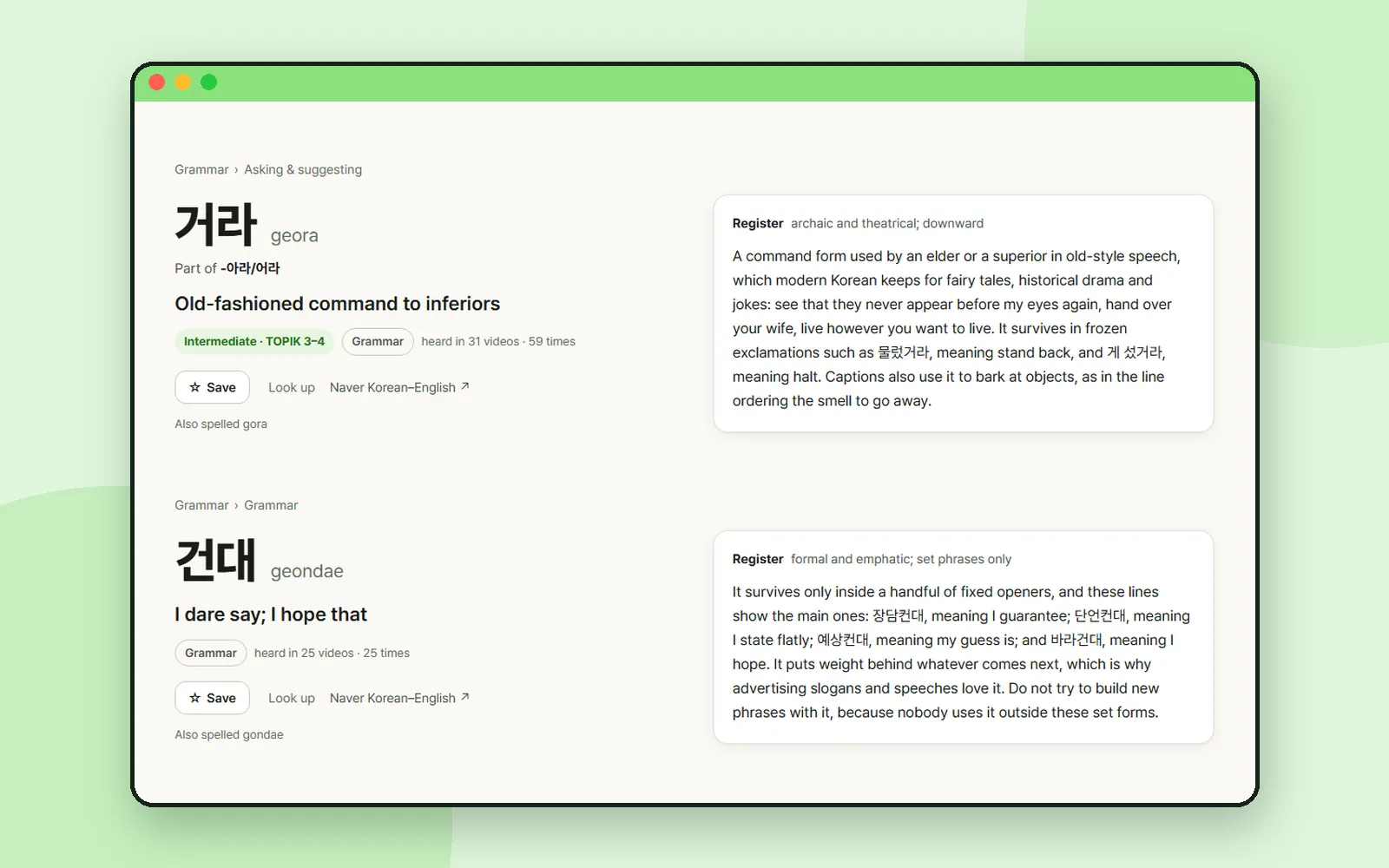
Both of these endings sound like they belong to another century, yet they keep turning up in Korean videos. -거라 is a command you would expect from a king in a historical drama; -건대 opens a sentence the way "I dare say" does in English. After the -구요 post, this time we look at two endings that survive mostly as style, using the explanations and real lines on Korean Out Loud.
ZZXXCCVV siteKorean Out Loud · 거라 (geora)Learn Korean through YouTube videosOpen1. -거라: the old-style command
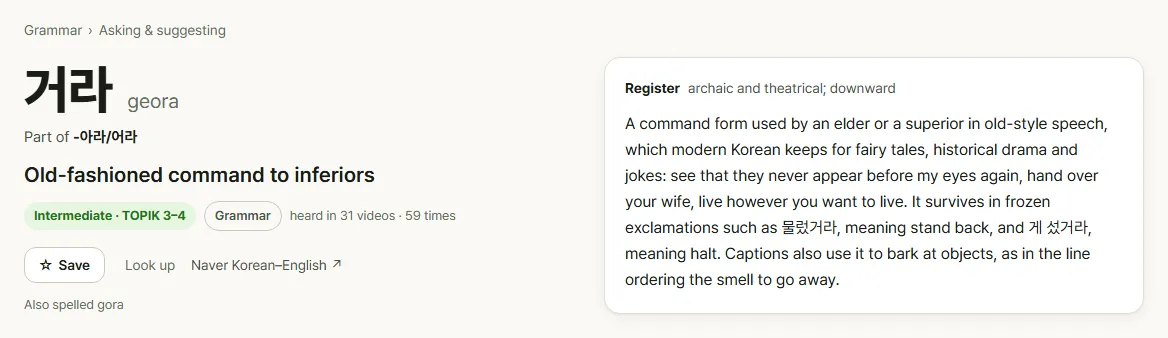
Korean Out Loud describes it as an "Old-fashioned command to inferiors", with the register "archaic and theatrical; downward". The page files it under "Asking & suggesting", as part of -아라/어라, and tags it "Intermediate · TOPIK 3–4".
-거라 attaches to a verb stem and gives an order from above: an elder to a child, a king to a subject. Modern Korean keeps it for fairy tales, historical dramas and jokes. These lines come from the -거라 page; the rough meanings are ours.
| Line on the page | Built from | Roughly |
|---|---|---|
| 늦었으니까 그만 자거라 | 자다 (to sleep) + 거라 | It's late, so go to sleep now. |
| 문을 활짝 열어두거라 | 열어두다 (to leave open) + 거라 | Leave the door wide open. |
| 너 살고 싶은 대로 살거라 | 살다 (to live) + 거라 | Live however you want to live. |
| 포기하지 말거라 | 말다 (to not do) + 거라 | Don't give up. |
The ending goes straight onto the stem, whether it ends in a vowel (자거라) or a consonant (살거라). For "don't", use 말다: -지 말거라.
Frozen phrases
Some -거라 commands have become fixed exclamations. The page points out two:
| Phrase | Meaning |
|---|---|
| 물렀거라 | Stand back! Make way! |
| 게 섰거라 | Halt! Stop right there! |
You will also hear -거라 used on things that cannot listen. One line on the page tells a cold to go away: 감기야 물렀거라, "Cold, stand back!"
How it compares with everyday commands
| Form | Sounds like |
|---|---|
| 저리 가 | Casual: "go over there" |
| 저리 가라 | Plain command, to a friend or someone younger |
| 저리 가거라 | Old-style and theatrical, like a scene from a historical drama |
2. -건대: an opener for what comes next
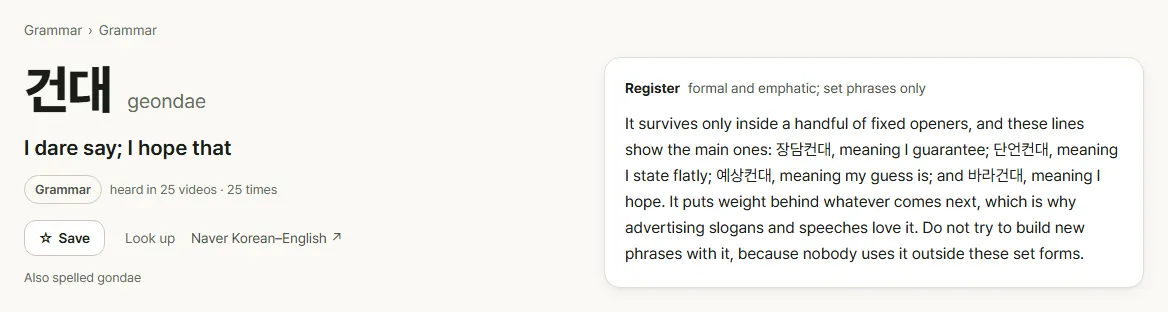
Korean Out Loud sums it up as "I dare say; I hope that", with the register "formal and emphatic; set phrases only".
-건대 attaches to a verb of saying, hoping or thinking and frames the sentence that follows. It is formal and emphatic, which is why it suits speeches and slogans, and why people also use it for mock-serious effect. These lines come from the -건대 page:
| Line on the page | Built from | Roughly |
|---|---|---|
| 바라건대.. | 바라다 (to hope) + 건대 | I hope... / If I may hope... |
| 제가 감히 단언하건대 | 단언하다 (to state flatly) + 건대 | If I may say so flatly... |
| 장담컨대 이게 나아 | 장담하다 (to guarantee) → 장담컨대 | I guarantee this one is better. |
| 하지만 내가 경고하건대 | 경고하다 (to warn) + 건대 | But I'm warning you... |
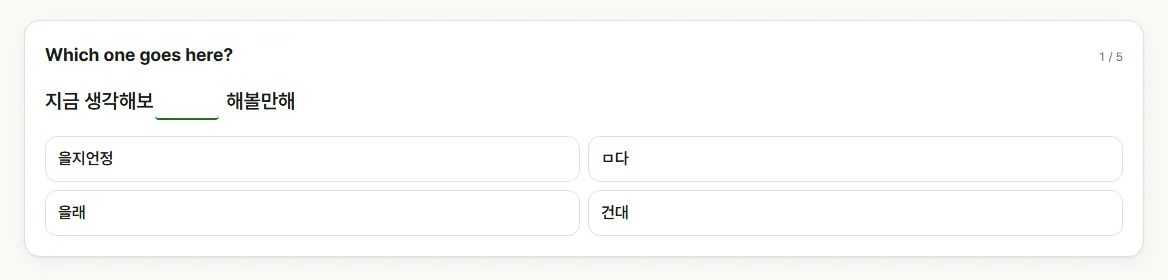
| 지금 생각해보건대 해볼만해 | 생각해 보다 (to think it over) + 건대 | Thinking about it now, it's worth a try. |
The page is clear that -건대 is not a pattern to build new phrases with. Learn the common openers as whole phrases:
| Set phrase | Use it to say |
|---|---|
| 바라건대 | I hope that... |
| 장담컨대 | I guarantee... |
| 단언컨대 | I state flatly... |
| 예상컨대 | My guess is... |
Why 하건대 turns into 컨대
When the verb ends in 하다, 하건대 is often shortened: the vowel of 하 drops and its ㅎ merges with ㄱ into ㅋ. So 장담하건대 becomes 장담컨대, and 단언하건대 becomes 단언컨대. Both the long and short forms appear on the page.
After a stem ending in ㄱ, ㄷ or ㅂ, standard spelling drops 하 completely instead: 생각하건대 becomes 생각건대. Subtitles do not always follow this rule; the -건대 page includes the caption spelling 추측컨대 as well.
3. Practice with the two pages
Coming up
In the next posts, we will keep introducing the ZZXXCCVV sites and how to use them.
Frequently asked questions
Can I use -거라 in everyday conversation?
Not as a normal command. It sounds like a king, an elder in a historical drama or a fairy-tale villain, so today it is mostly used on purpose: for dramatic effect, as a joke with friends, or to scold an object. Never use it to someone older than you.
What is the difference between 장담하건대 and 장담컨대?
They are the same phrase. When 하 comes before -건대, it is often shortened so that 하건대 becomes 컨대. Both spellings appear on the -건대 page of Korean Out Loud.
Can I attach -건대 to any verb?
In practice, no. Korean Out Loud notes that it survives only in a handful of fixed openers such as 바라건대, 장담컨대, 단언컨대 and 예상컨대, and advises learning them as set phrases.
Where can I hear these endings in real Korean?
The -거라 and -건대 pages on Korean Out Loud collect real sentences from Korean YouTube videos that use them. Pick a sentence to hear just that moment.