Korean Out Loud
What does Korean -구요 mean? The spoken -고요, with real examples
-구요 is the relaxed spoken spelling of -고요, a polite ending that means "and, there's more". How it attaches, how it differs from -군요, and where to hear it.
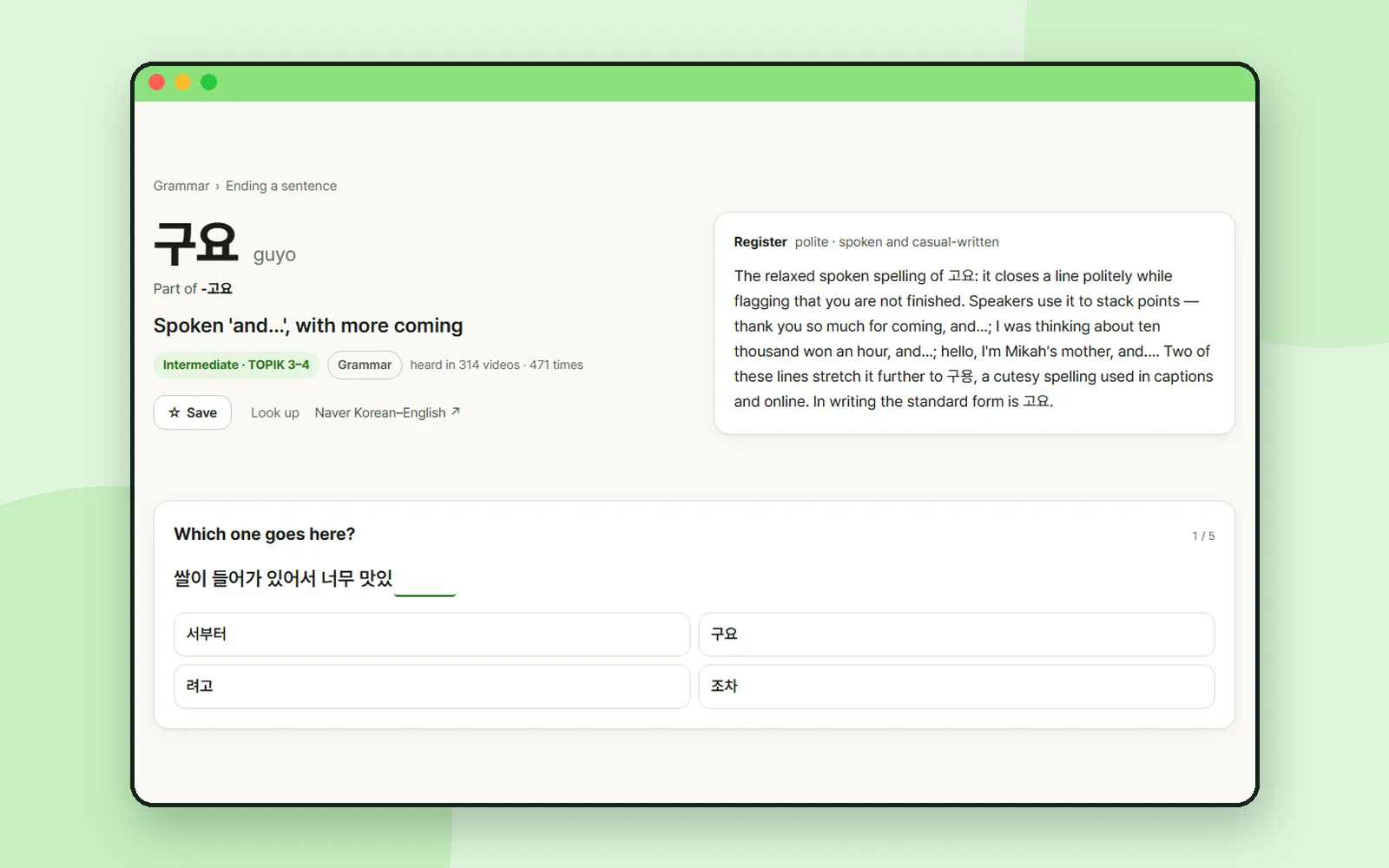
Watch Korean videos with subtitles for a while and you will see lines ending in -구요 again and again. In the Korean Out Loud post, it was our example of an expression page. This time we look at what -구요 actually means, using the explanation and the real lines on that page.
ZZXXCCVV siteKorean Out Loud · 구요 (guyo)Learn Korean through YouTube videosOpen1. -구요 in one sentence
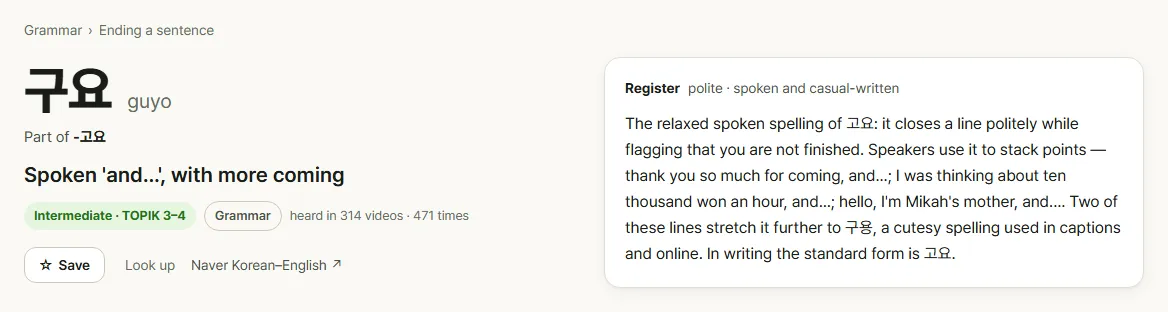
Korean Out Loud sums it up as "Spoken 'and...', with more coming". The page files it under "Ending a sentence", as part of -고요, and tags it "Intermediate · TOPIK 3–4".
-구요 is the relaxed, spoken spelling of -고요. It closes a sentence politely while signaling that you are not finished yet, so speakers use it to line up one point after another. The site notes that in writing, the standard form is -고요.
| Part | What it does |
|---|---|
| -고 | Links to what comes next, like "and" |
| -요 | Makes the sentence polite |
| -구요 | -고요 spelled the way it often sounds in speech |
The page marks its register as "polite · spoken and casual-written". It also points out a playful variant, -구용, which shows up in captions and online.
2. How it attaches, with lines from real videos
These are lines from the -구요 page. Each one comes from a different Korean YouTube video, and the rough meanings are ours.
| Line on the page | Built from | Roughly |
|---|---|---|
| 그리고 이 티셔츠도 좋구요 | 좋다 (to be good) + 구요 | And this T-shirt is nice too, and... |
| 김치도 있구요 | 있다 (there is) + 구요 | There's kimchi too, and... |
| 전 시간당 만 원 정도 생각을 했구요 | 했다 (did, past tense) + 구요 | I was thinking of about 10,000 won an hour, and... |
| 첫번째 게임이구요 | 게임 (game) + 이구요 | It's the first game, and... |
| 그래서 맛있는 거구요 | 거 (thing) + 구요 | That's what makes it tasty, and... |
The pattern is simple:
- Verbs and adjectives: add -구요 to the stem, as in 좋구요 and 있구요. For the past tense, add it after the past form, as in 했구요.
- Nouns: after a final consonant, use -이구요, as in 게임이구요. After a vowel, -구요 is enough, as in 거구요.
3. Don't mix it up with -군요
-구요 and -군요 look almost the same, but they do different jobs.
| Ending | Feeling | Example |
|---|---|---|
| -구요 | Adding a point, with more to come | 맛있구요 "It's tasty, and..." |
| -군요 | Reacting to something you have just noticed | 맛있군요 "Oh, it's tasty!" |
If a sentence ends in -구요 and the speaker keeps talking, it is the "and..." ending. If the speaker sounds surprised or impressed and stops there, you are probably hearing -군요. Korean Out Loud has a -군요 page as well, so you can listen to the two endings one after the other.
4. Practice with the -구요 page
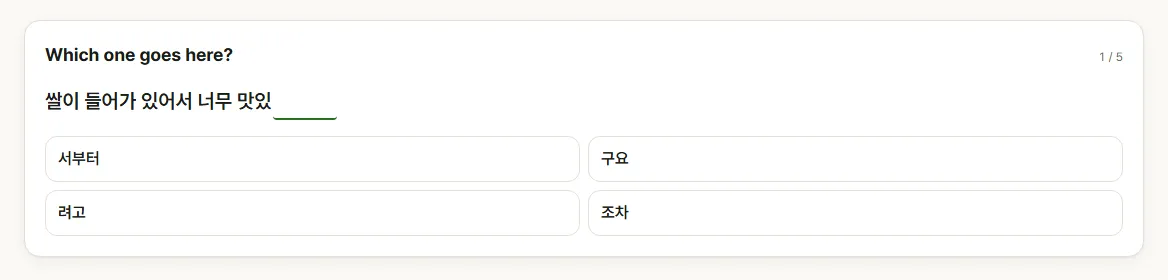
Korean Out Loud has heard -구요 in more than 300 videos, and the page picks out real sentences from them for you to play. Here is one way to practice with it:
Coming up
In the next posts, we will keep introducing the ZZXXCCVV sites and how to use them.
Frequently asked questions
Is -구요 polite?
Yes. It ends in 요, the polite ending. -구요 is a relaxed spelling, though, so in careful writing the standard form -고요 is used instead.
What is the difference between -구요 and -고요?
They are the same ending. -구요 spells -고요 the way it often sounds in speech, which is why you see it in subtitles, captions and online comments.
Is -구요 the same as -군요?
No. -구요 links one point to the next, like "and...", while -군요 reacts to something you have just noticed or learned, like "oh, I see".
Where can I hear -구요 in real Korean?
The -구요 page on Korean Out Loud collects real sentences from Korean YouTube videos that use it. Pick a sentence to hear just that moment.