Lookwave
What does the world look up about Korea? Reading Lookwave's Wikipedia maps
Lookwave maps weekly Wikipedia page views of Korea-related articles by country. How to read its globe, country and keyword pages, and what the numbers do not mean.
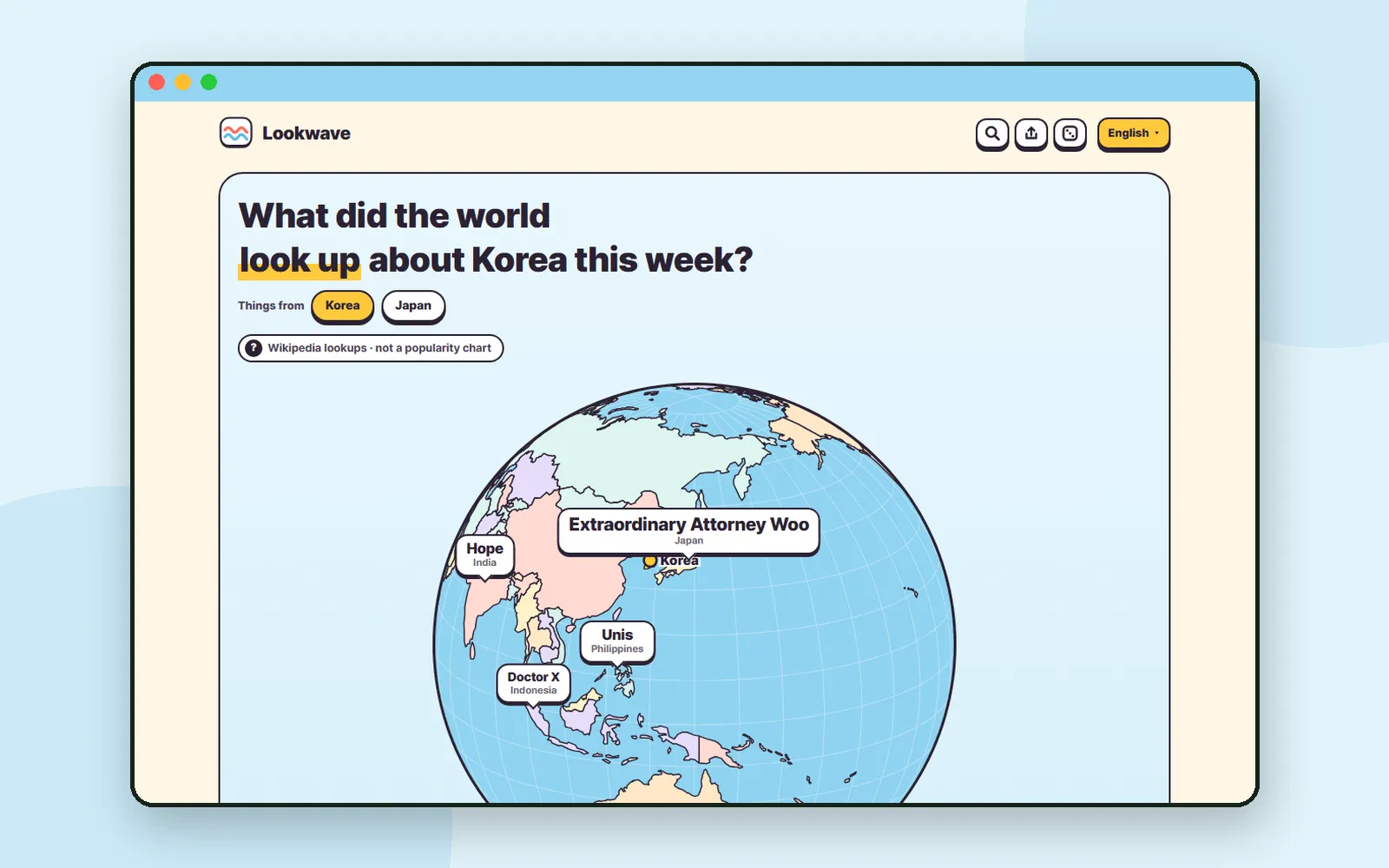
When a Korean drama, a singer or a dish starts drawing attention abroad, it is hard to tell where. Wikipedia leaves one public trace: every article has a count of how often it was read, and Wikimedia publishes those counts by country. Lookwave turns page views from more than 300 Wikipedia language editions into maps of what the world looks up about Korea, where, and how much. There is no sign-up.
This guide walks through the front page, a country page, a category and a single keyword, then explains what the numbers measure and what they do not.
ZZXXCCVV siteLookwaveWhat the world looks up about Korea on WikipediaOpen1. Start with the globe
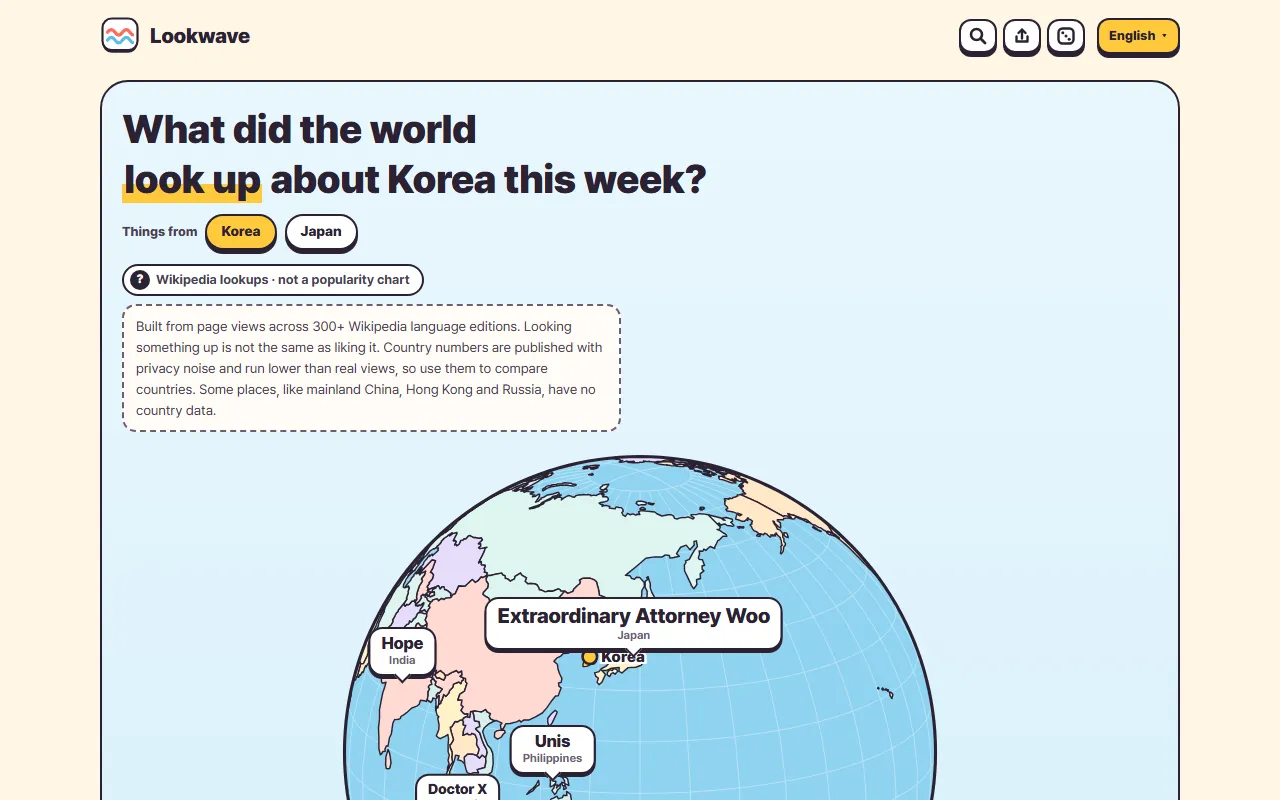
The front page opens on a globe. Each speech bubble sits over a country and names the thing from Korea that people there looked up most in the last 7 days. "Spin the globe · tap a bubble for more", as the page puts it.
Further down the same page:
- Keywords surging right now: things looked up far more than usual, with links to Today's wave, Just starting to spread and the Weekly report.
- Press a country key: a keyboard of country codes. Each key shows that country's share and keywords, with a link to its own page.
- What the world looked up about Korea this week: the overall list, with chips for Dramas, Films, Artists, Actors, Sports, Games & webtoons, Food and Places.
- This week in photos: only keywords that have a freely licensed photo, each with its credit and licence.
- And the other way: what did Korea look up?: the reverse view, from readers of the Korean-language Wikipedia.
The three keys at the top right are Find a keyword, Share and Surprise me, which opens a random keyword page.
2. One country at a time
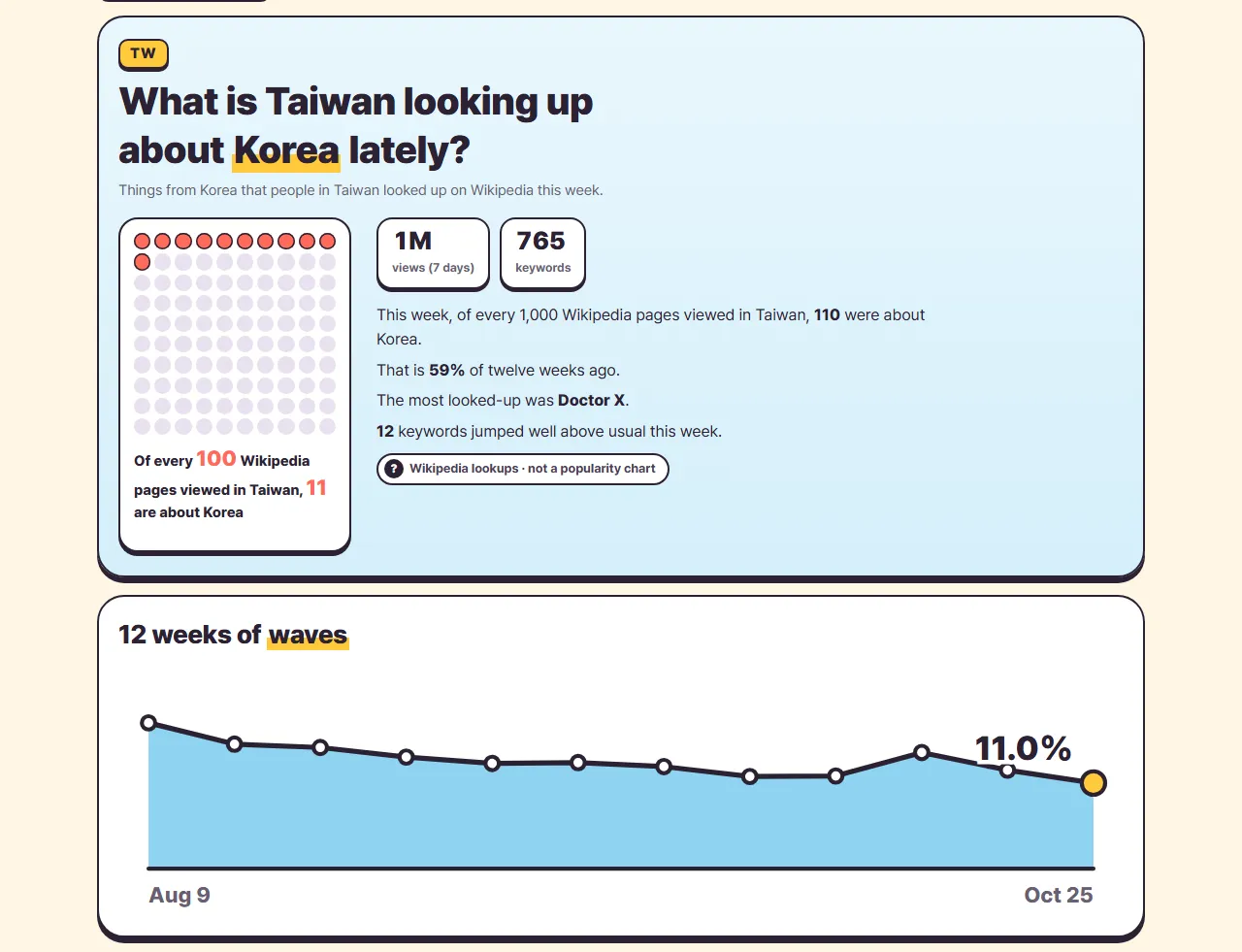
A country page answers one question: what do people in that country look up about Korea? Open one from a country key or a bubble on the globe.
The grid of 100 dots shows the share within the country: of all the Wikipedia pages read there, the part about Korea. In the capture above, taken on 1 November, that was 11 in 100 for Taiwan. It is a share, not a count, which makes it easier to compare a large country with a small one.
Below it:
- 12 weeks of waves: the same share, week by week.
- Taiwan's keywords this week, with a multiplier on keywords that rose against their usual level.
- Newly surging this week and By category, which splits the week's views into artists, dramas, actors and so on.
3. One category on many maps
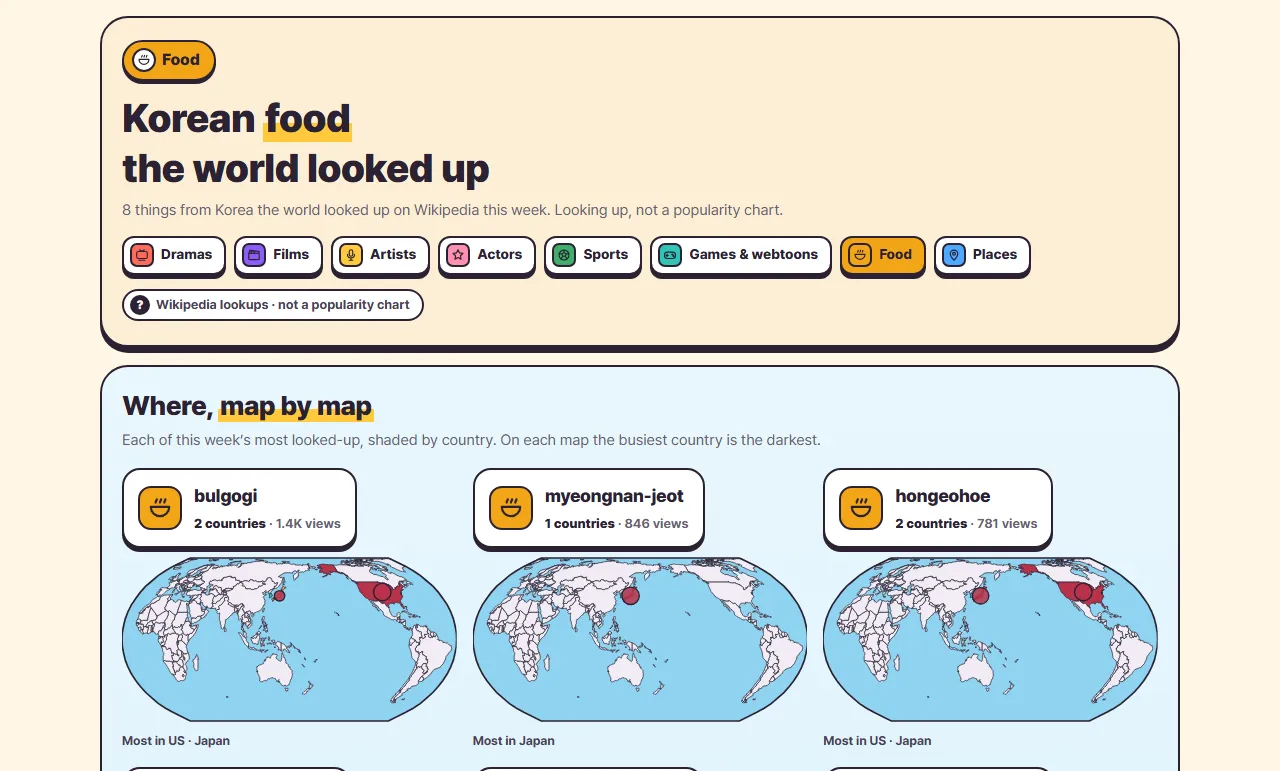
Pick a chip such as Food or Places and you get a category page. Where, map by map gives each keyword its own small world map, shaded by country, with the busiest country darkest on each map. Laid side by side, the maps show at a glance that one dish was looked up mostly in one country and another in several.
4. Inside a keyword
Names on the site open keyword pages. Here is bulgogi. At the top are freely licensed photos and the opening lines of the Wikipedia article in the language you are reading, each credited with its licence, and a Read on Wikipedia link.
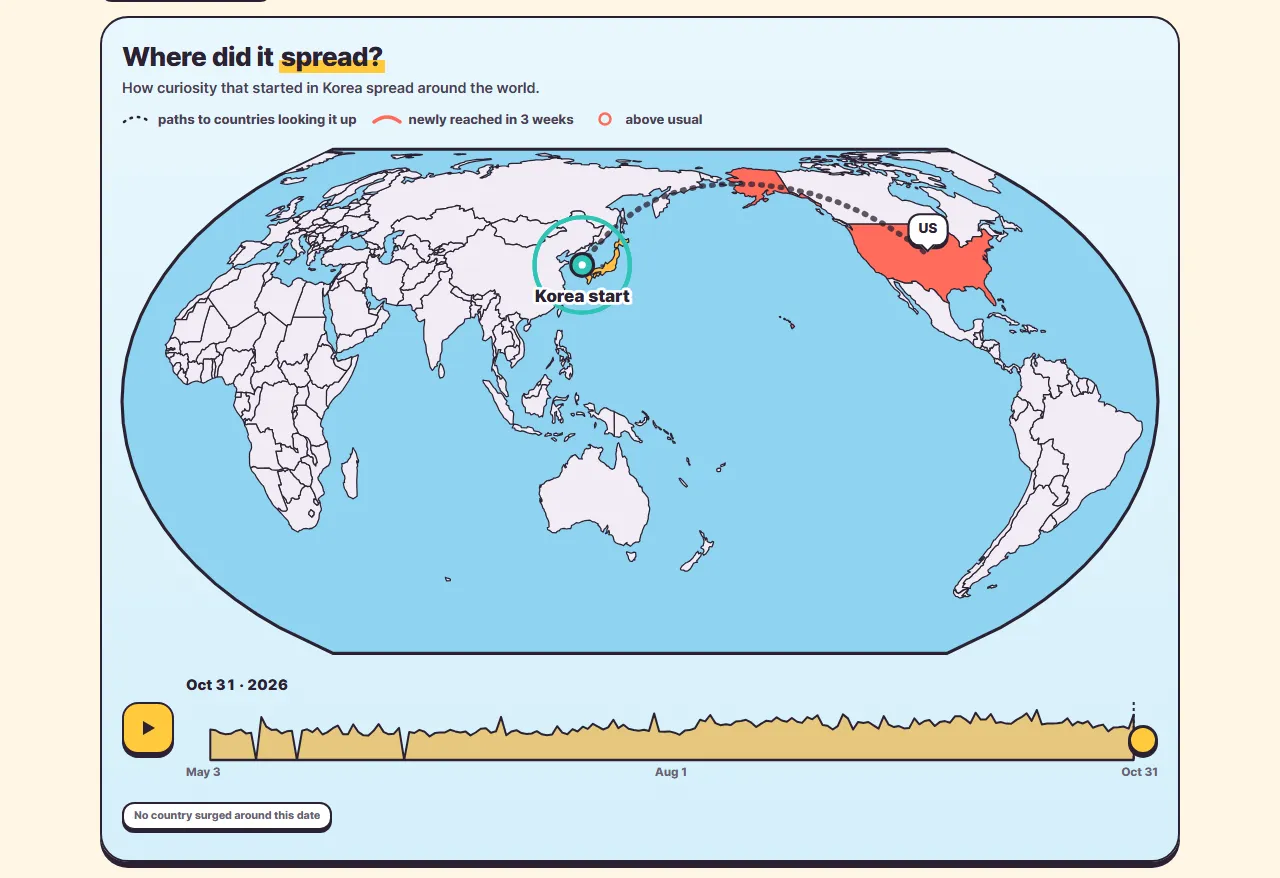
Where did it spread? draws curiosity travelling out from Korea, with dotted paths to the countries that looked it up. Countries newly reached in the last three weeks are marked, and a timeline with a play button runs underneath, from early May to the latest day.
Further down:
- Where people looked it up and In which languages: the same interest split by country and by Wikipedia edition.
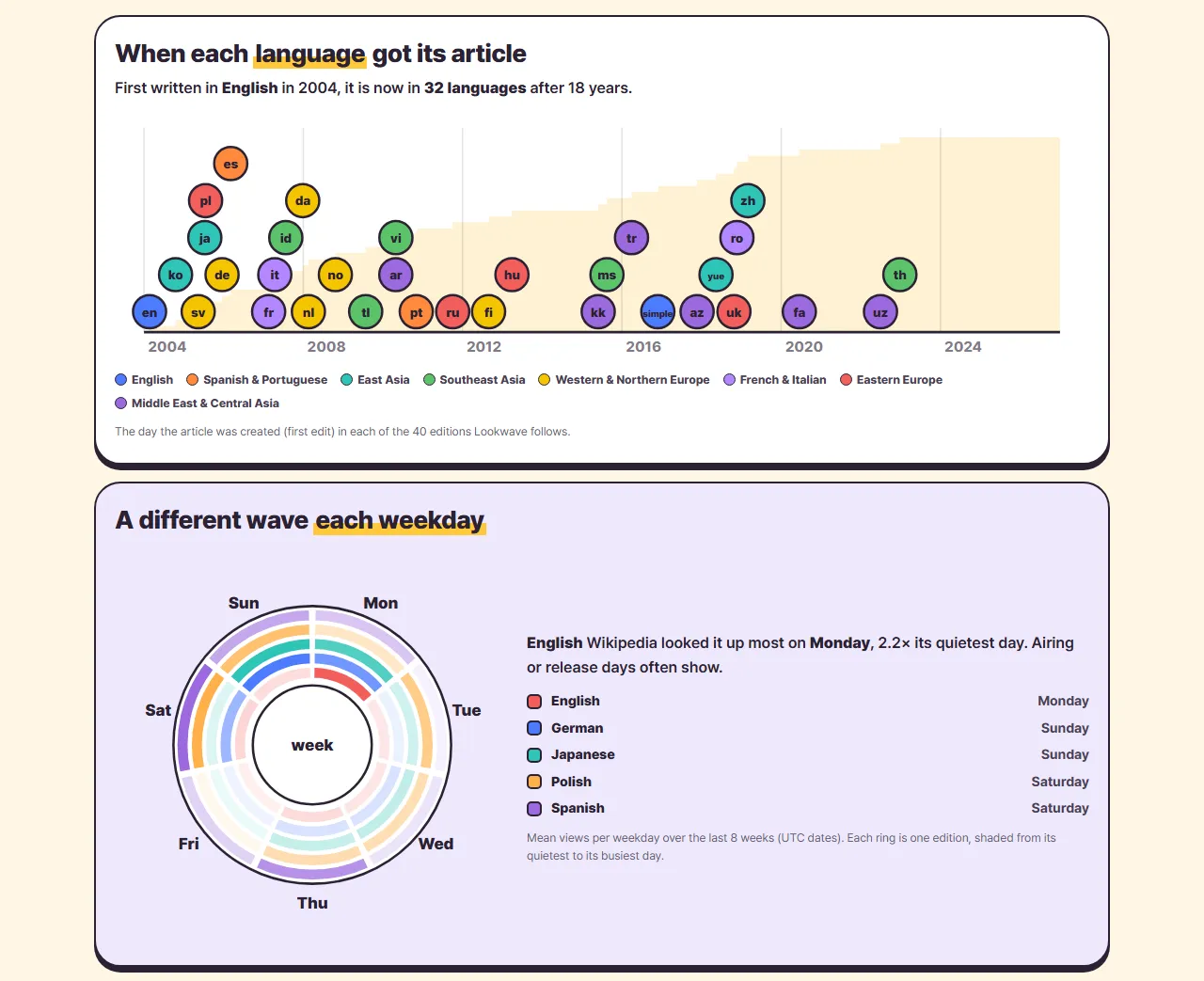
- When each language got its article: the date the article was first created in each of the 40 editions Lookwave follows.
- A different wave each weekday: which weekday each edition reads the article most, over the last 8 weeks. The site notes that airing or release days often show here.
- Compare with another keyword: put a second keyword on the same page.
5. Daily, weekly and the other way round
| Page | What it shows |
|---|---|
| Today's wave | Things that jumped to more than twice their 4-week average yesterday. People who jump suddenly appear only after a check, since news or a death can be the cause |
| Just starting to spread | Things that began to rise in one to three countries for the first time that week |
| Weekly report | One page per week: the most looked-up, the biggest jumps, spread to new countries and the share of Korea in each country. Past reports go back to early 2025 |
| What Korea looked up from the world | Dramas, films, singers, actors, sports and games from other countries that people in Korea looked up |
The last one comes with a caution from the site itself: Korea uses Wikipedia less than many countries, so its numbers are small.
6. What the numbers mean, and what they don't
Lookwave repeats one line on every page: looking something up is not the same as liking it. Its About page adds that page views are not ratings or sales, nor a contest between countries. A drama, a singer or an athlete can be looked up because of a new release, an award or a news story, and the count alone cannot tell you which.
How the site counts, from its About page:
| Measure | Meaning |
|---|---|
| Views | The last 7 days. All times are UTC |
| Share within a country | Of all Wikipedia pages viewed in that country, the part about the origin country |
| Versus usual | The last 7 days compared with the 4 weeks before |
| Where the wave reached | The first day each country went above 1.8× usual with at least 300 views in a week |
A few more things the site states plainly:
- What it leaves out: politicians, incidents, crime, disasters and scandals, however often they are looked up.
- Photos and text: only the opening sentences of a Wikipedia article (CC BY-SA 4.0) and freely licensed photos from Wikimedia Commons, each credited next to it. No posters, album covers or other non-free images.
- Categories are set from Wikidata automatically and checked by people. If you spot a mistake, the Corrections link at the bottom of every page sends a request.
If you would rather see what is playing than what is being read, Trenvid compares YouTube trending charts across countries. See What is the world watching today?. And if all those Korean titles make you want to understand them, Korean Out Loud teaches Korean with real videos.
Next
Next, we look at Traffic Jack, a comic car action game played on a real map of Seoul.
Frequently asked questions
Where does Lookwave's data come from?
From Wikipedia page views. Views by country come from data the Wikimedia Foundation publishes every day (CC0), views by language edition from Wikimedia's page view data (human readers only), and names and categories from Wikidata (CC0).
Does a high number mean something is popular?
No. The site says so on every page: looking something up is not the same as liking it, and it is not ratings, sales or a contest between countries. A spike can also come from news.
Why do some countries show no data?
Wikimedia does not publish country figures for some places, including mainland China, Hong Kong, Russia, Vietnam and Iran, so Lookwave shows them as no data. According to the site, interest from the Chinese edition comes mostly from Taiwan.
How often is Lookwave updated?
Daily, following Wikimedia's daily data. Weekly totals cover the last 7 days, all times are in UTC, and finished weeks are kept as weekly reports.
Do I need an account?
No. The site's privacy page says Lookwave has no accounts and does not collect names or email addresses.