Aha!So
How an everyday thing ended up this way: the long reads on Aha!So
Instant noodles began in 1958 Japan and turned spicy in Korea. How Aha!So's long reads follow one ordinary thing, and how to read their timelines and figures.
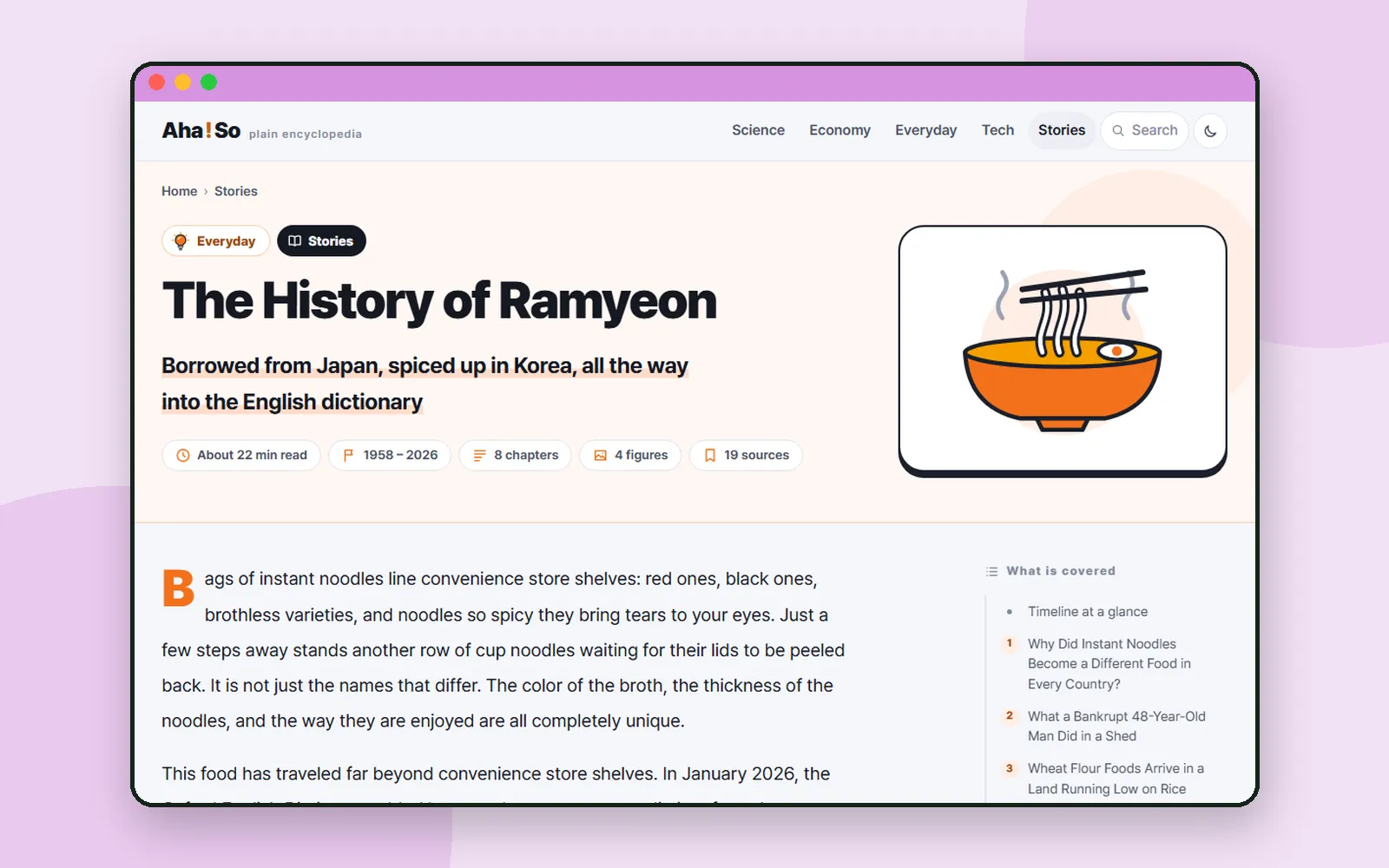
When you pick up a pack of instant noodles, you probably do not think of a bankrupt man in a shed in 1958 Japan. The long reads on Aha!So follow exactly that: the history of one ordinary thing, from the very beginning. Last time we checked a keyboard and a screen; this time, something to read.
ZZXXCCVV siteAha!So · Long readsHard ideas explained with one everyday comparisonOpen1. Picking one from the list
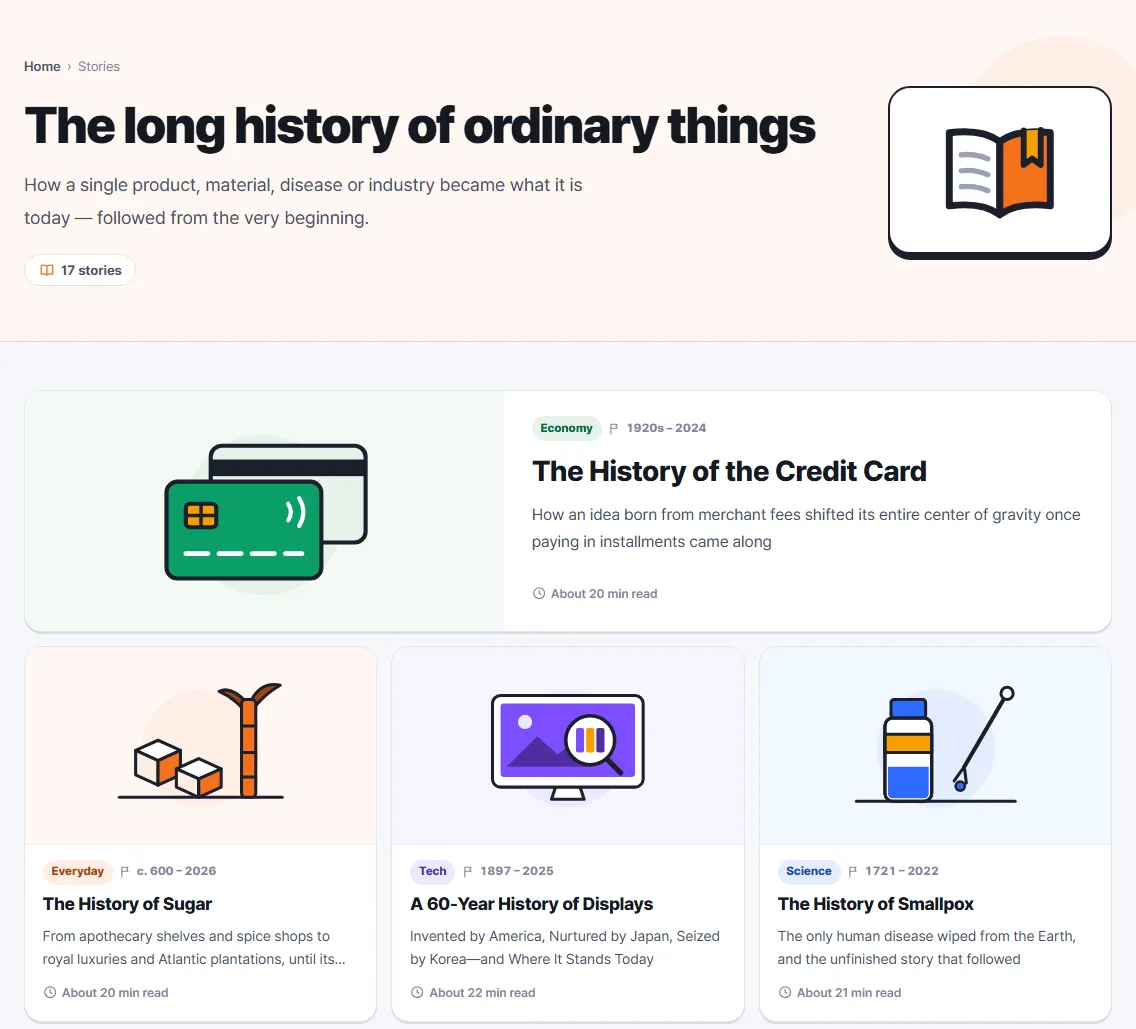
Open "Stories" in the top menu and you get a row of cards. Each one shows the area, the span of years the story covers and the reading time, so it is easy to pick. Coffee, instant noodles, insurance, plastic, container shipping — the subjects vary, and new ones keep being added. Most take 20 to 30 minutes.
2. Following one: The History of Ramyeon
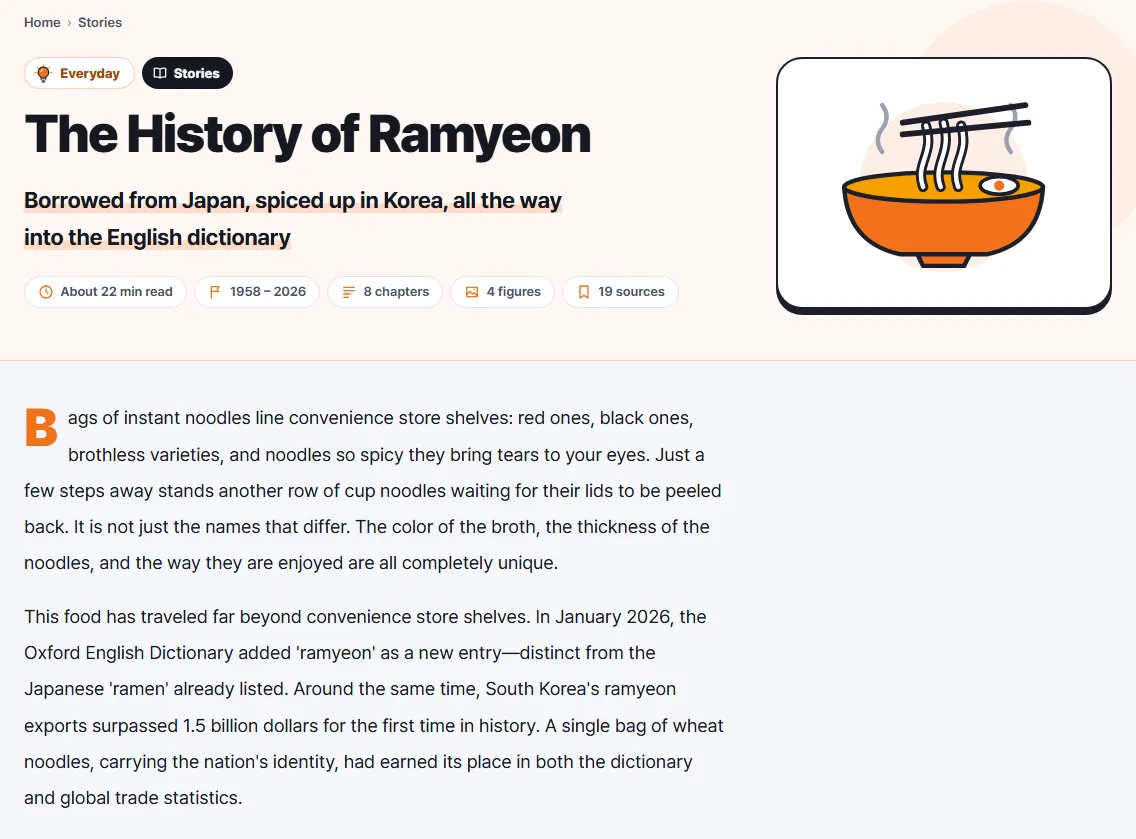
The subtitle gives you the shape of the story before you start: "Borrowed from Japan, spiced up in Korea, all the way into the English dictionary". The opening starts at a convenience store shelf, moves to the Oxford English Dictionary adding 'ramyeon' in January 2026 and to a record export figure, and then makes its point: the product is younger than you think, having first appeared in 1958.
Under the title, chips give you the size of the read up front: about 22 minutes, 1958 – 2026, 8 chapters, 4 figures and 19 sources. The eight chapter titles sit in "What is covered" on the right (a strip at the top on a narrow screen), which marks the chapter you are in as you read. Several read like a scene rather than a heading — "What a Bankrupt 48-Year-Old Man Did in a Shed" — so you can tell where the story is going.
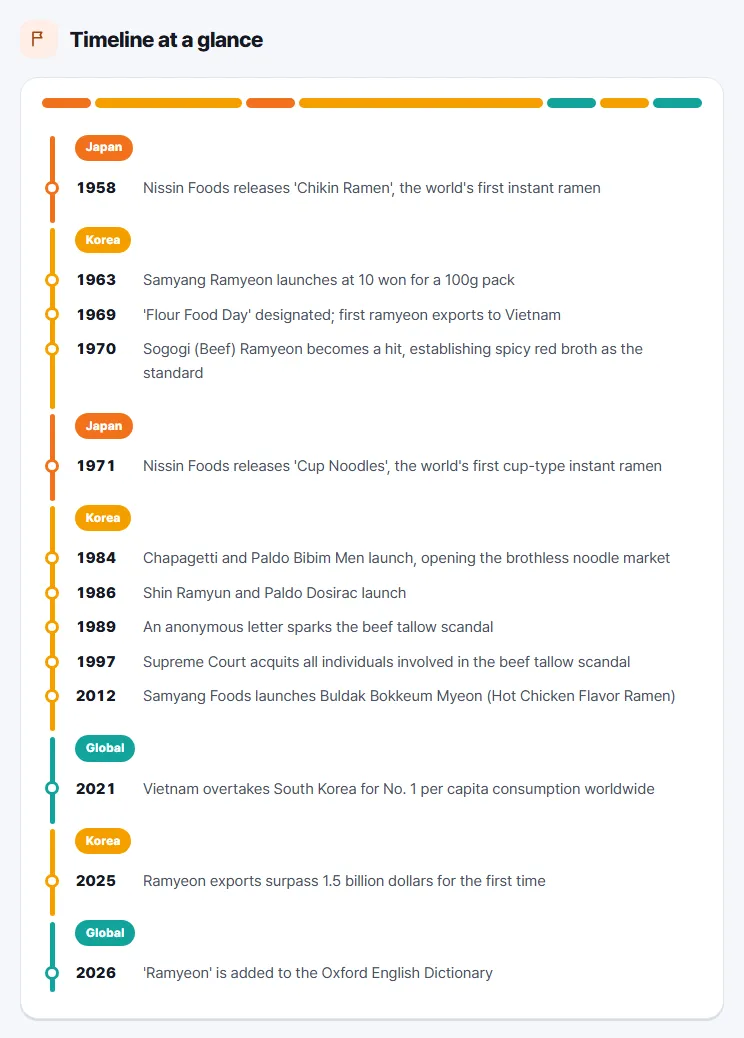
After the opening comes the timeline, with each event tagged Japan, Korea or Global, so you can see what happened where first: Chikin Ramen in 1958, Samyang Ramyeon in 1963, the spicy red broth becoming the standard in 1970, cup noodles in 1971, brothless noodles in 1984, the beef tallow scandal in 1989 and the acquittal in 1997, Vietnam overtaking Korea in per capita consumption in 2021, exports passing 1.5 billion dollars in 2025, and the dictionary entry in 2026.
3. Figures come with a date, diagrams with a mechanism
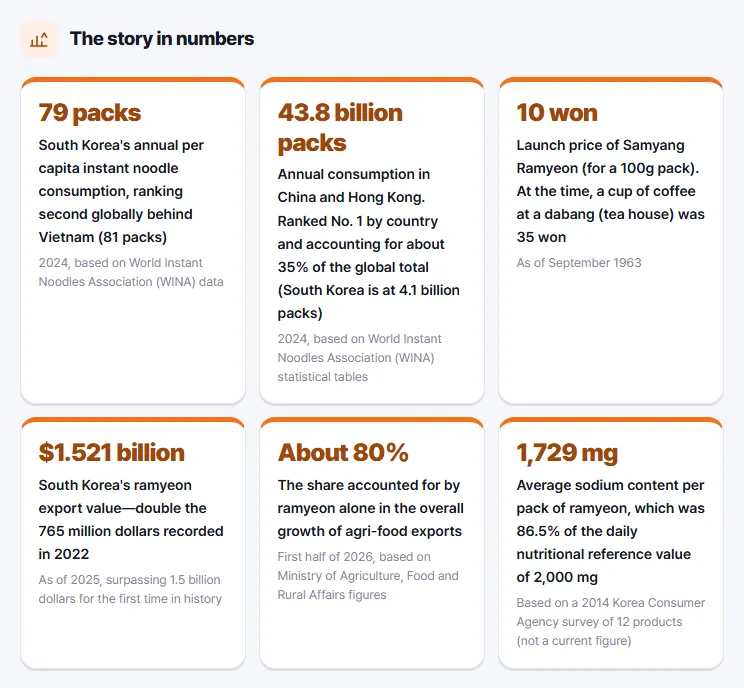
In "The story in numbers", at the end of the first chapter, every figure carries the year and the body that compiled it: 79 packs per person a year (2024, World Instant Noodles Association, second behind Vietnam's 81), 43.8 billion packs in China and Hong Kong (about 35% of the world), 10 won for the first Samyang Ramyeon in 1963, and 1.521 billion dollars of exports in 2025.
The one to notice is the average sodium figure, 1,729 mg per pack. It is labelled "based on a 2014 Korea Consumer Agency survey of 12 products (not a current figure)". The story shows the number and tells you how old it is in the same breath.
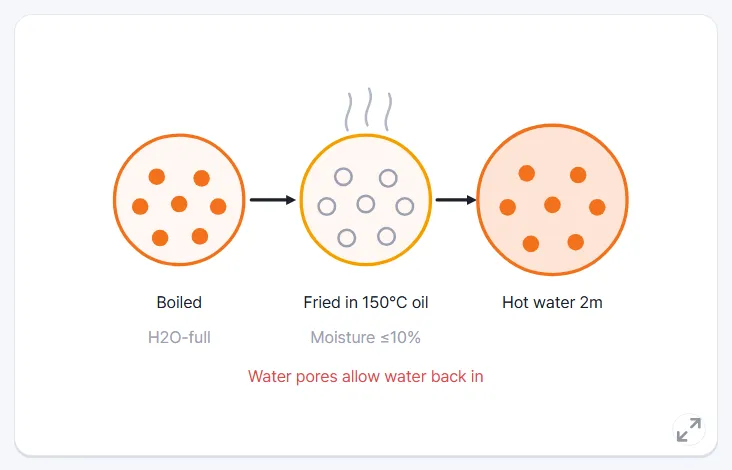
Diagrams show up where a mechanism needs explaining. This one is flash-fry drying. Boiled noodles are fried in oil at around 150°C until their moisture drops below 10%, leaving pores where the water used to be; pour hot water in later and it seeps through those pores and brings the noodles back. The story then takes one step further: instant noodles keep because they are dry, not because of preservatives, and what sets the shelf life is how fast the oil in the noodles turns rancid.
4. What is documented, and what is only repeated
The part that makes these long reads trustworthy is that they mark where the record ends and the retelling begins.
| Passage | How the story handles it |
|---|---|
| Rairaiken in Tokyo, 1910, as the first ramen shop | Widely cited, but the story adds that Chinese restaurants in treaty ports were already serving similar noodles, so sources differ on what counts as first |
| Chicken Ramen costing several times a bowl of udon | Presented as something "widely cited", not as a checked fact |
| The average sodium figure | Carried with the survey year and an explicit note that it is not current |
That habit lets you judge which parts you can quote yourself. The "Sources" section at the end lists what the dates and figures are based on.
5. Three languages, and an RSS feed
The long reads are available in English, Korean and Japanese, and you can switch language at the bottom of the page. New ones come through a separate RSS feed for long reads, so you can follow them without the concept articles.
Coming up
Next time: Trenvid, and how to compare what is trending on YouTube from one country to another.
Frequently asked questions
How long does one long read take?
Each card shows its reading time, usually 20 to 30 minutes. The example here, The History of Ramyeon, is listed at about 22 minutes.
How is a long read different from a concept article?
A concept article explains one idea in about five minutes, starting from a single everyday comparison. A long read follows the history of one product, material, disease or industry, chapter by chapter, with a timeline, key figures and a list of sources.
Where do the figures come from?
Every figure is labelled with the year it refers to and the body that compiled it, and the sources are listed at the end. Older survey figures carry a note saying they are not current.
Can I read the long reads in another language?
Yes. They are available in English, Korean and Japanese, and you can switch language at the bottom of the page. New ones have their own RSS feed, separate from the concept articles.