Aha!So
Heard of it, but can't explain it? How to use Aha!So
Aha!So explains ideas like entropy and opportunity cost with one everyday comparison each. How to find a concept, how each article is laid out, and the long reads.
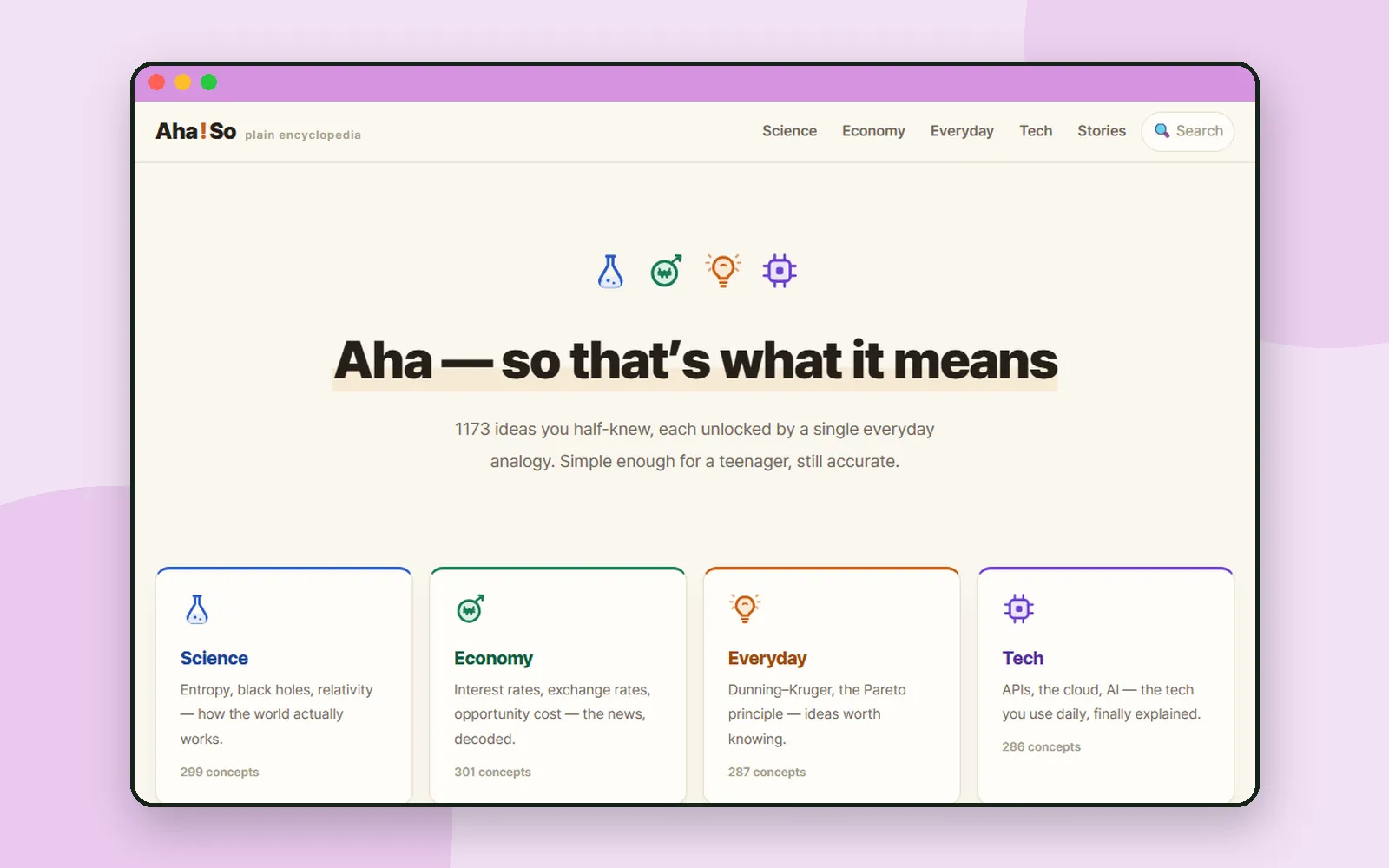
You have probably heard words like "opportunity cost" or "entropy" and felt you roughly knew what they meant, until someone asked you to explain. In PICNICI Global we planned a day out. This time it is a place for making sense of ideas like these.
Aha!So is a plain-language encyclopedia that explains ideas you half know, each with one everyday comparison. It has more than 1,100 concepts across science, economy, everyday life and tech, plus long reads that follow the history of a single topic. There is no sign-up.
ZZXXCCVV siteAha!SoHard ideas explained with one everyday comparisonOpen1. Find a concept
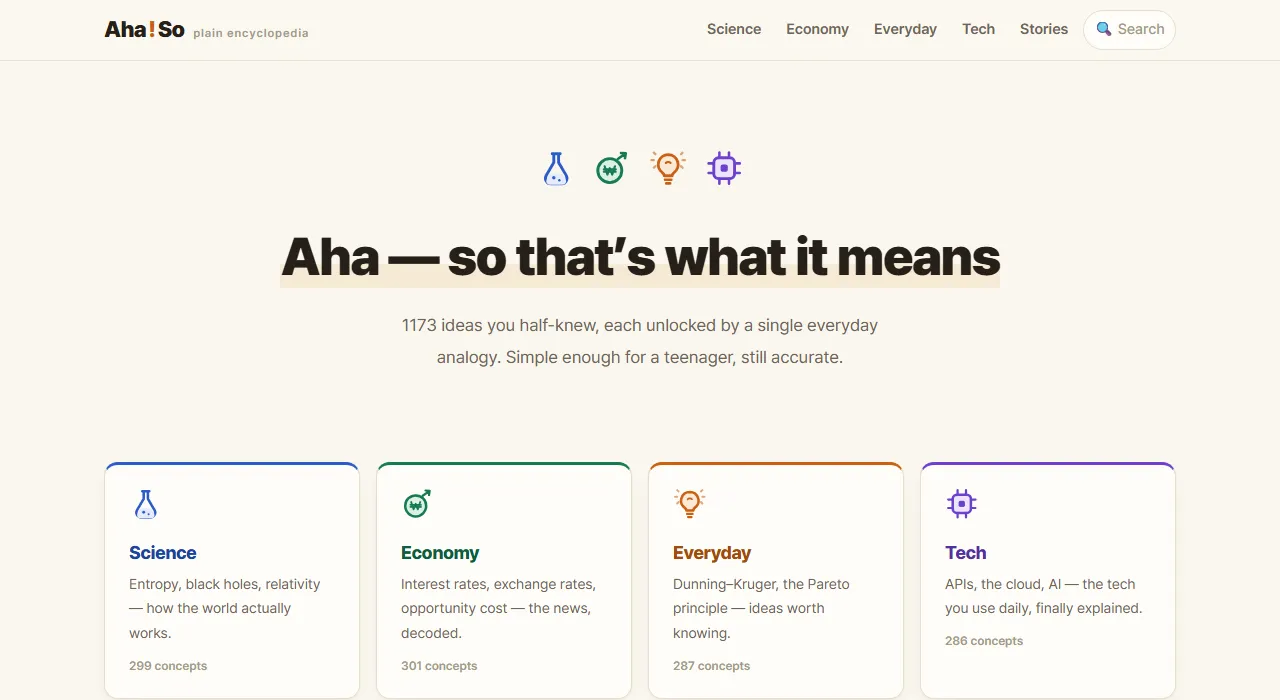
There are three ways in:
2. How every article is laid out
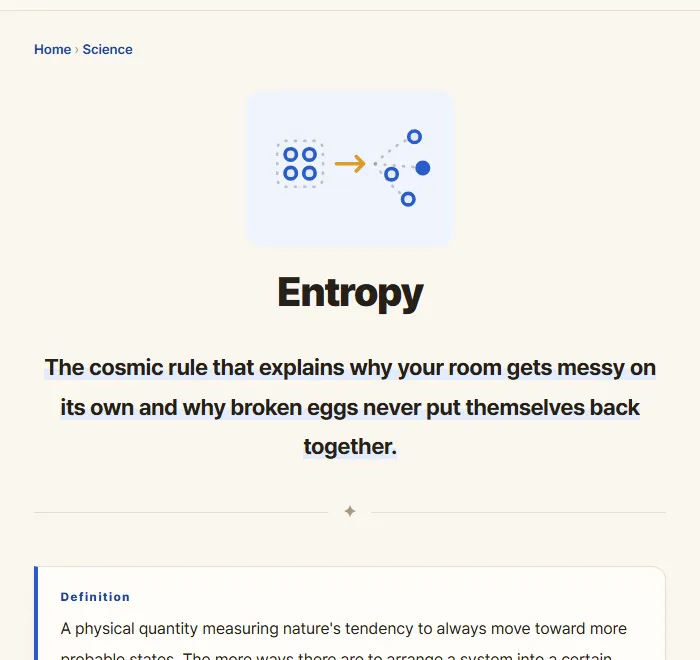
Every concept article follows the same order, so once you have read one, you know where to look in the next. The entropy article, for example, opens with this one-line analogy right under the title:
The cosmic rule that explains why your room gets messy on its own and why broken eggs never put themselves back together.
| Part | What it gives you |
|---|---|
| One-line analogy | The idea summed up in one everyday scene |
| Definition | The precise meaning, briefly |
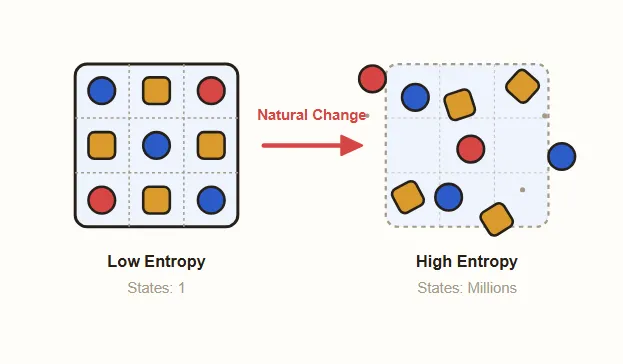
| Body and diagrams | Two or three short sections, each with a diagram |
| 🤔 Common misconceptions | What people often get wrong, set against what is true |
| 🧺 Where you meet it | Situations where the idea shows up in real life |
| 💡 In one sentence | The idea again, in a single sentence |
| 🔗 Read next | Related concepts to read next |
3. Long reads
If a concept article is a quick explanation, a long read is a long article that follows how one product, material, disease or industry became what it is today, from the very beginning. Open "Stories" in the top menu, or "Long reads" on the front page.
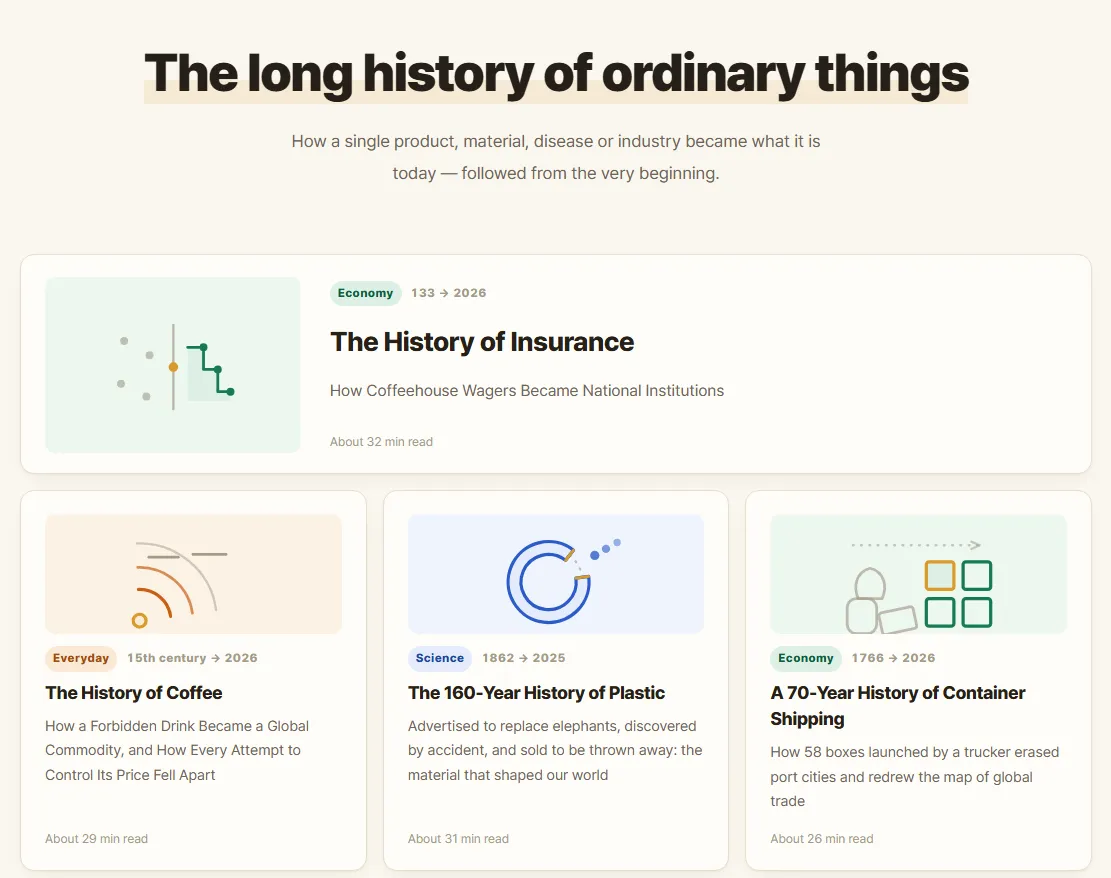
Topics include coffee, ramyeon, insurance, plastic and container shipping, and new stories keep being added. Each card shows the area, the span of years the story covers and the reading time, so it is easy to pick one. Most take around half an hour.
How a long read is put together
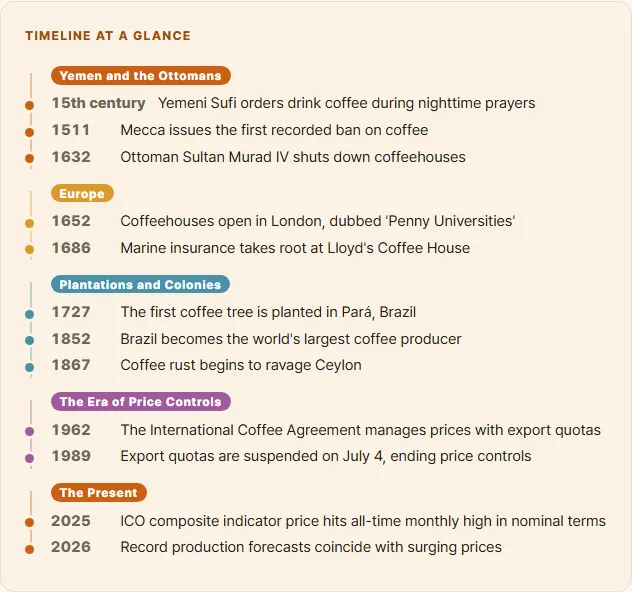
Take The History of Coffee as an example. It reads in this order:
Careful with figures and famous anecdotes
What sets the long reads apart is how they handle facts. The coffee story spends its whole first chapter on how to read the numbers. In coffee statistics, a "bag" means 60 kg of unroasted green beans, and the crop year starts in a different month in different countries. Misread a unit, and every figure after it looks different.
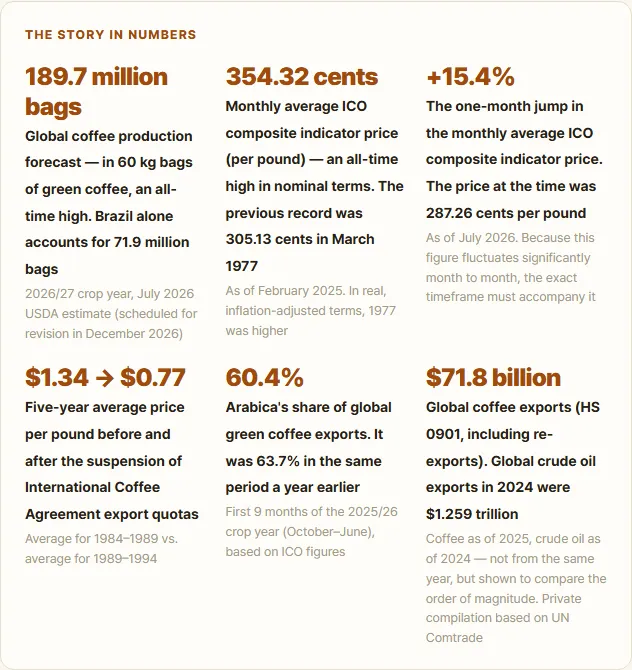
Every figure in "The story in numbers" states what was measured and when. Famous anecdotes are not simply repeated either. The story points out that the legend of Kaldi the goatherd first appeared in print some 800 years after the time it is set in, and that it is now generally seen as a later invention. The dates and figures in the text are based on the sources listed at the end, and the coffee story lists more than 30 of them.
4. How the articles are made
Aha!So researches each article across a range of sources and checks the facts before publishing. Each article shows when it was created, updated and verified, and long reads also list the sources they are based on. If you spot a mistake, use "Report an error" at the bottom of the article, and you can tell the site whether an analogy helped with a thumbs up or down.
5. Reading in other languages, and RSS
Concept articles and long reads are available in English, Korean and Japanese, and you can switch languages at the bottom of the page. Reading the same concept in two languages is a handy way to practice. For updates, there are separate RSS feeds for concept articles and for long reads.
Coming up
From the first post to this one, we have introduced the ZZXXCCVV sites one at a time. In the next posts, we will keep going, with one site and how to use it in each post.
Frequently asked questions
What kind of concepts does Aha!So cover?
More than 1,100 concepts across four areas: science, economy, everyday life and tech. They are ideas you meet in the news or in class, such as entropy, compound interest, opportunity cost and inflation.
What are the long reads?
Long articles that follow how one product, material, disease or industry, such as coffee, ramyeon or insurance, became what it is today. They are split into chapters with a timeline, the story in numbers and a list of sources, and most take around half an hour to read.
How are the articles made?
Each article is researched across a range of sources and fact-checked before it is published. Every article shows when it was verified, long reads list their sources, and you can use Report an error if you spot a mistake.
Can I get updates?
Yes. There are separate RSS feeds for concept articles and for long reads.