Hanzi Move
Stroke order, one brushstroke at a time: a guide to Hanzi Move
Watch any Chinese character, kanji or hanja being written one brushstroke at a time. Compare the orders of four regions, trace it yourself and print worksheets.
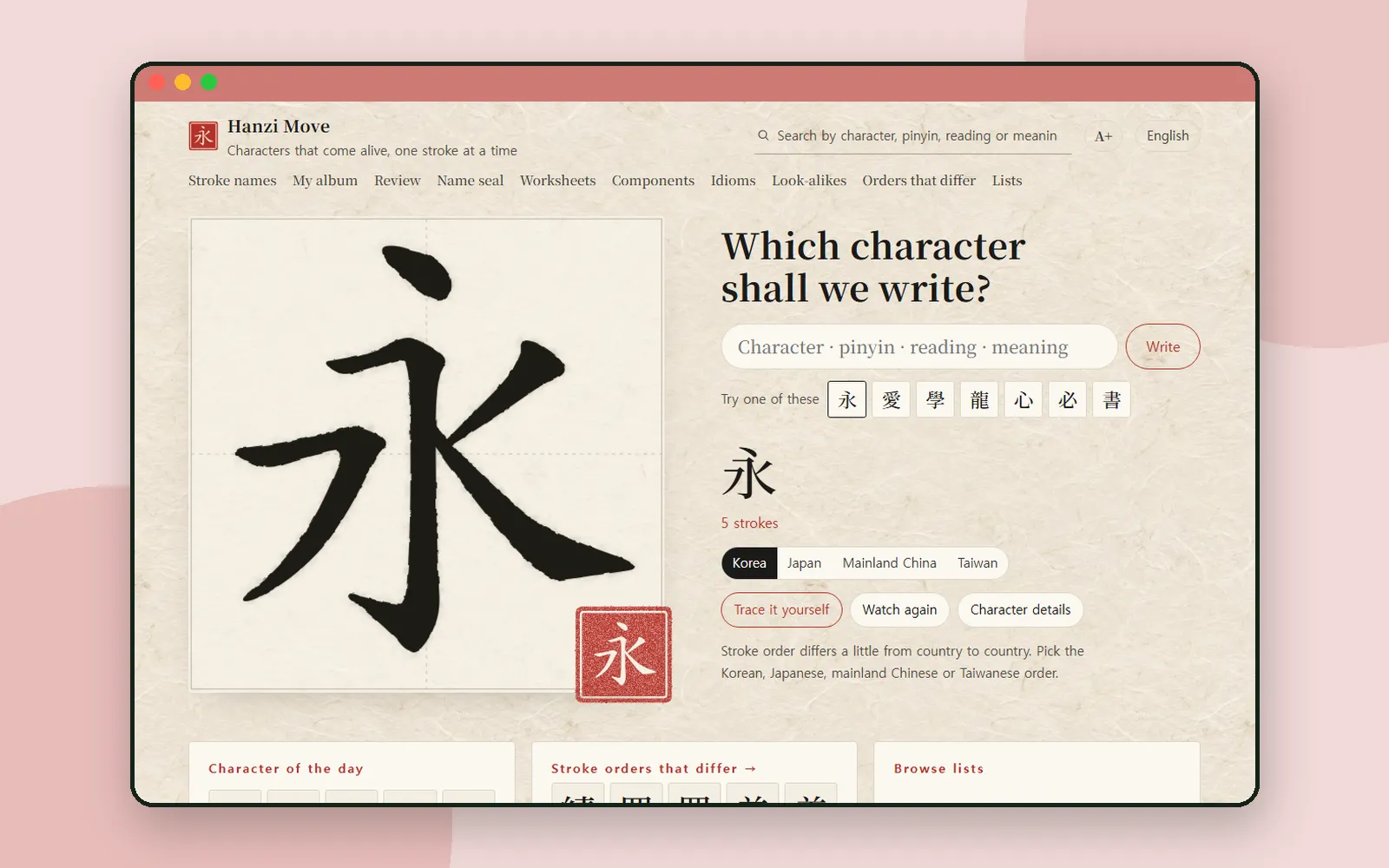
Learning a character means learning how to write it: which stroke comes first, which way each one moves, where it ends. A still diagram with tiny numbers only gets you so far. Hanzi Move gives every character its own page and draws it the way a brush would, one stroke at a time. You can then trace it yourself, compare how it is written in Korea, Japan, mainland China and Taiwan, and print a practice sheet. There is no sign-up.
This guide walks through a character page, the four-region comparison, tracing practice and the worksheet maker.
ZZXXCCVV siteHanzi MoveHanzi, kanji and hanja stroke order, one brushstroke at a timeOpen1. Pick a character
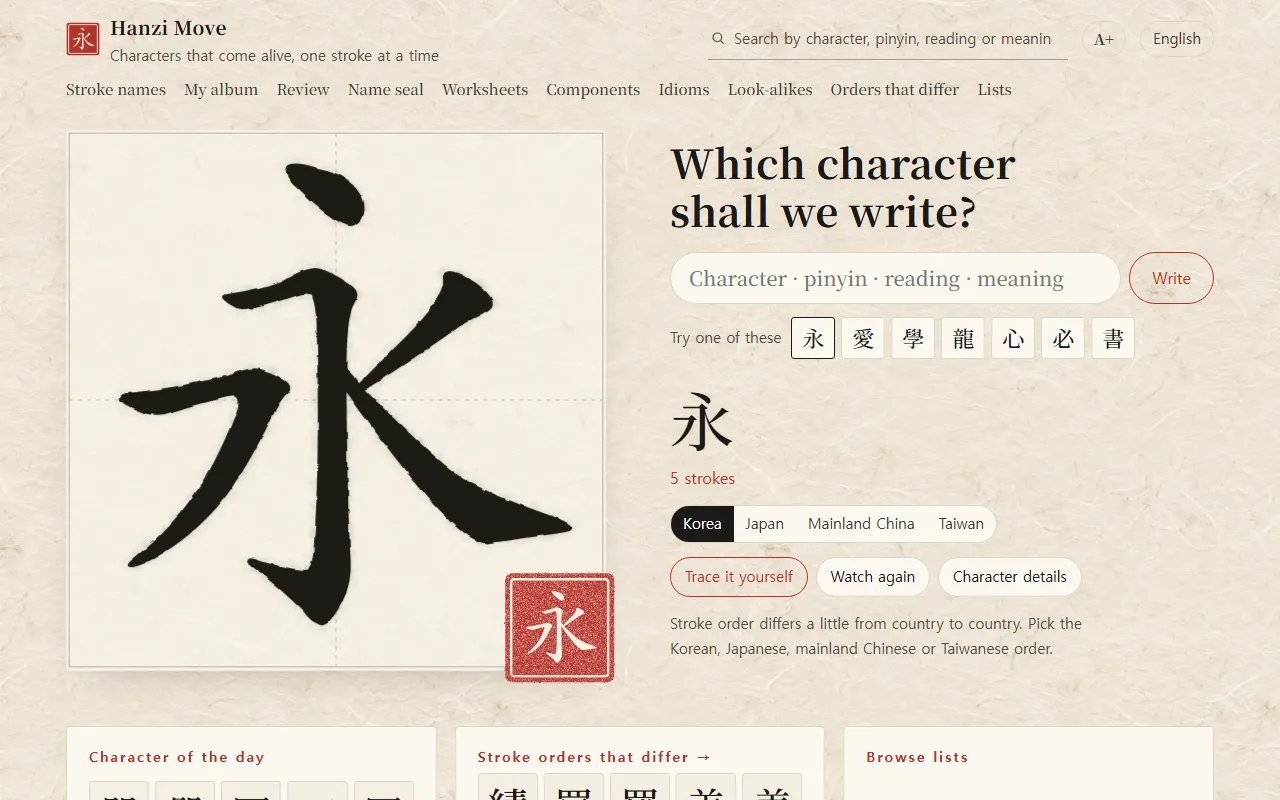
The front page asks "Which character shall we write?" and starts with 永 (eternal), the character calligraphy students have long practised first. Press one of the sample characters, or type into the box. You can search by:
- the character itself, pasted or typed with your keyboard's Chinese or Japanese input
- pinyin, or a Japanese reading in kana
- an English meaning: "love" brings up 愛, 恋, 爱 and a few others, each with the meaning that matched
Below that, Character of the day offers five characters each day from Korea's basic hanja for education, and Stroke orders that differ shows five where the four regions disagree. Browse lists lets you pick from HSK 3.0 levels, Jōyō kanji, Korea's basic hanja and other official lists.
2. One character, one page
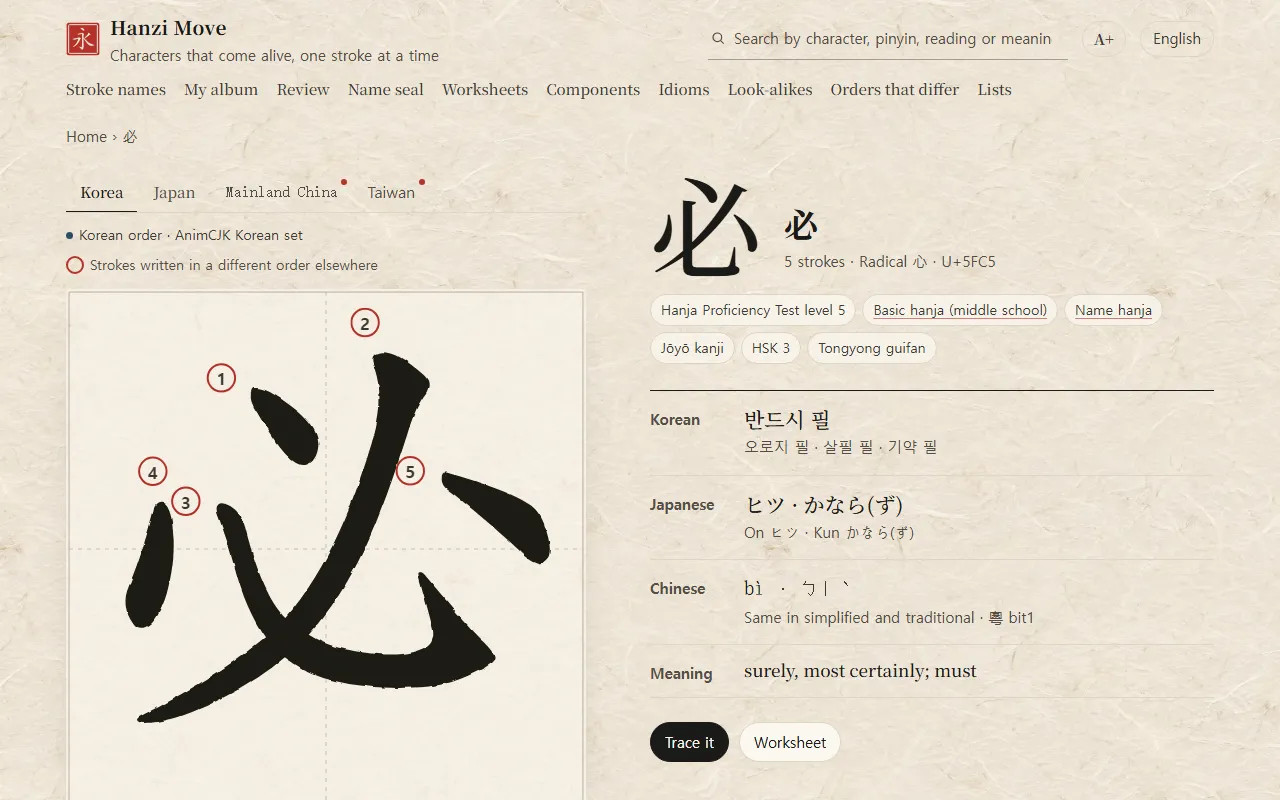
Open Character details and the character is drawn stroke by stroke in ink. The controls under it let you:
- Play the animation again, at Slow, Normal or Fast
- turn on Numbers to see where each stroke starts, and Stroke names to list every stroke in order (for 必: top dot, left-falling, lying hook, left dot, right dot)
- switch between the Korea, Japan, Mainland China and Taiwan tabs. Each tab names its source, such as "Japanese order · AnimCJK". A small red dot on a tab marks a region whose order differs. When all four regions agree, as they do for 永, the page simply says "All four countries use the same order".
Next to the drawing is a short profile: stroke count, radical and code point; which lists the character belongs to (HSK level, Jōyō kanji, Korea's Hanja Proficiency Test level and so on); and readings in three languages. For 必, that is Korean 반드시 필, Japanese ヒツ · かなら(ず), Chinese bì, plus the English meaning "surely, most certainly; must".
Scroll down for more:
- Building the character splits the character into its components. Put together and Take apart move the pieces, and each component links to other characters that contain it.
- History of the character explains where the form comes from, quotes the entry in the Shuowen Jiezi, an early Chinese character dictionary, and for some characters shows older forms of the character. Each explanation carries a label such as "Several theories" and the date the editors reviewed it.
- Words with this character lists Korean, Japanese and Chinese words. Some Japanese and Chinese words come with an example sentence from Tatoeba.
3. When regions write it differently
Stroke order is not the same everywhere. The site puts it plainly: "Stroke order can differ between countries, and even between textbooks in one country." 必 is the classic example, and its page has a section called Four countries, side by side.
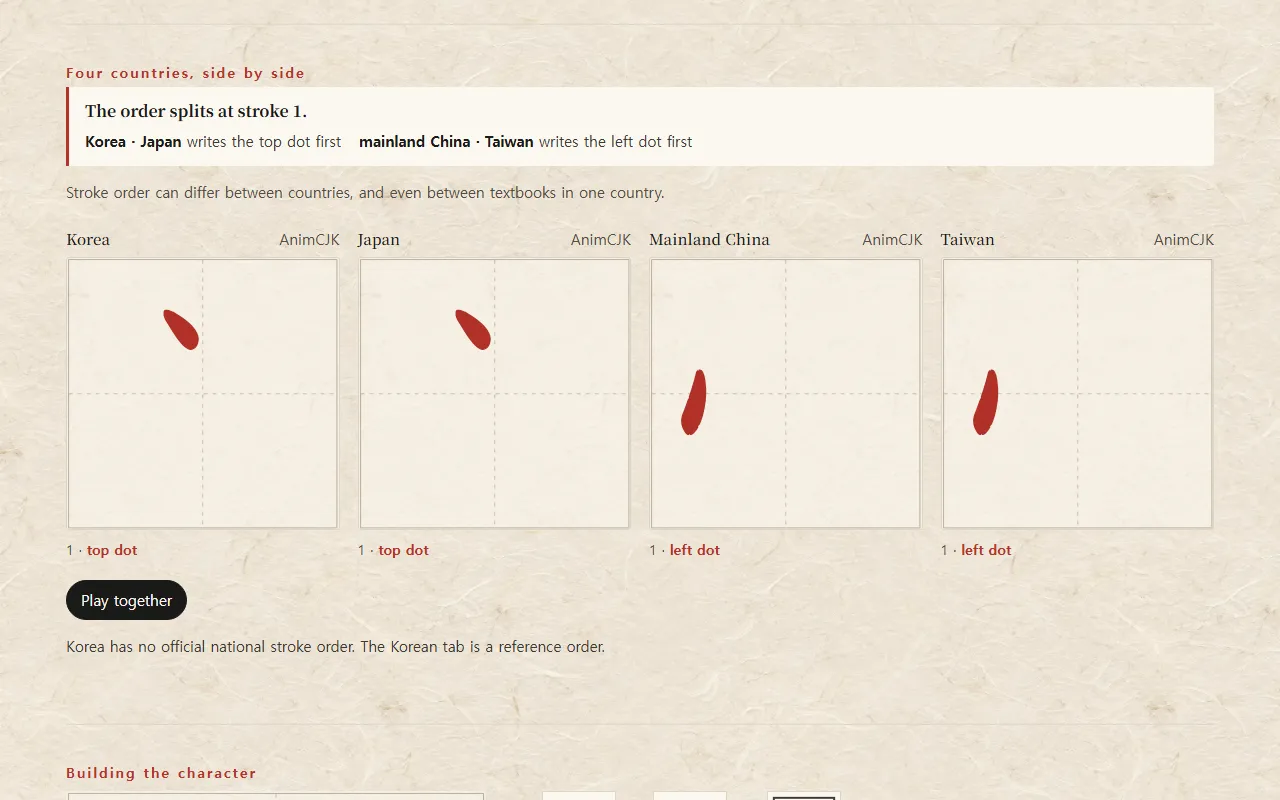
Press Play together and all four versions are drawn at once. Here the difference shows from the first stroke. Korea and Japan start with the dot at the top, while mainland China and Taiwan start with the dot on the left. A note above the boxes sums up which regions share which order.
The Orders that differ page in the top menu collects characters like this. It also lists the official stroke-order standards that exist:
| Region | Standard named on the site |
|---|---|
| Mainland China | 现代汉语通用字笔顺规范 (1997) |
| Taiwan | 常用國字標準字體筆順手冊 |
| Japan | 筆順指導の手びき (1958) |
| Korea | No official national stroke order confirmed. Hanzi Move's Korean order is for reference |
The site does not claim that its data follows these documents. Every tab names its own source, AnimCJK's set for that region, and the site's terms say its stroke orders are reference material. If your teacher or textbook writes a character differently, follow them for exams and class. If you think a stroke order on the site is wrong, use the Different stroke order? link at the bottom of the character page.
4. Trace it yourself
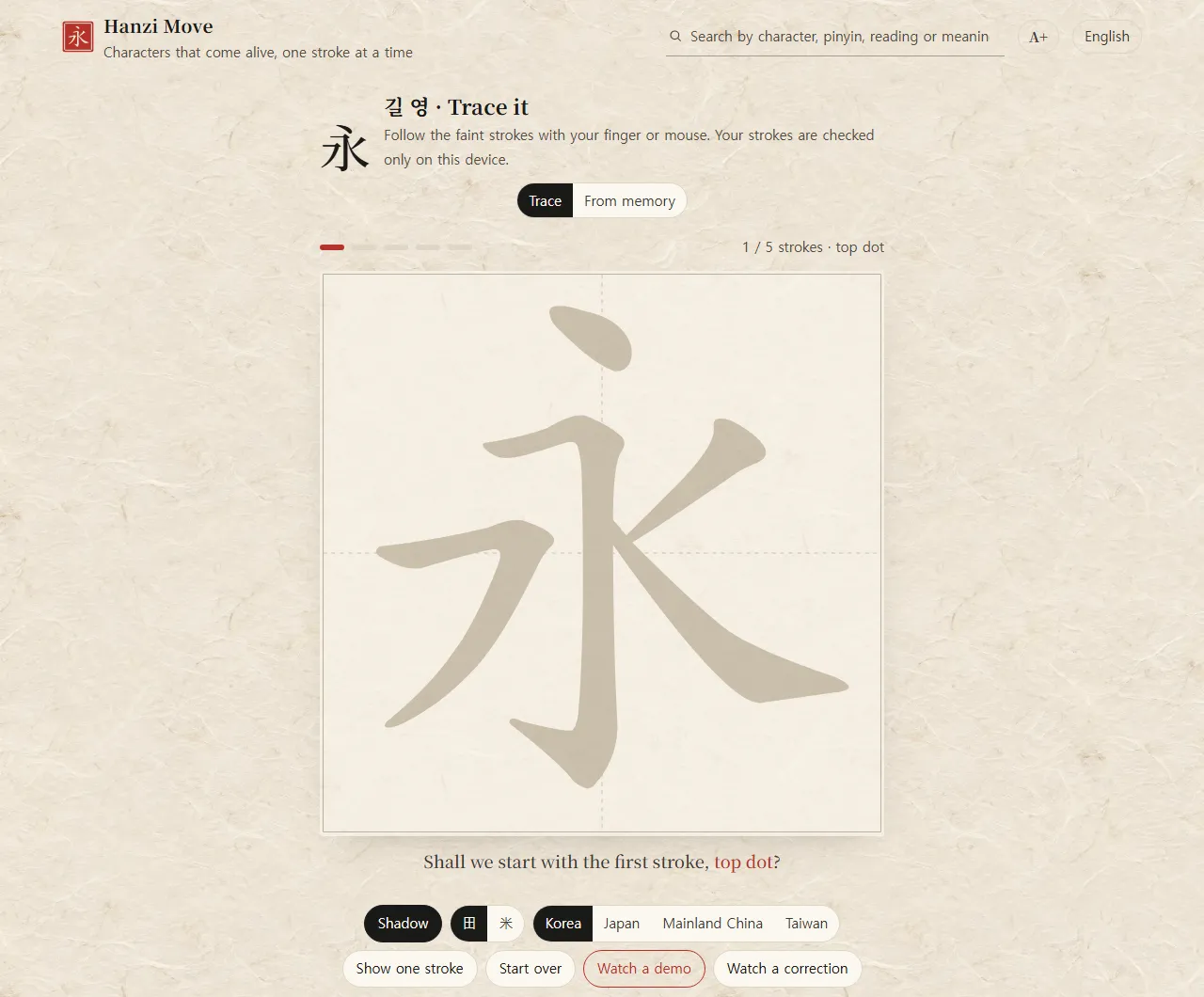
Press Trace it on a character page, or Trace it yourself on the front page. The character appears in faint grey, and you write over it with a finger or a mouse, stroke by stroke. The counter above the box tells you which stroke comes next and what it is called.
The buttons under the box change the practice grid. Shadow turns the faint outline on and off, and 田 and 米 switch between a four-square and an eight-way guide grid. Your strokes are checked on your own device and are not sent to the server.
Two more pages build on this:
- My album keeps every character you finish tracing, one page each, in your own handwriting. You can lay the model over your version, or put several characters on one sheet and save it as an image.
- Review brings each character back after 1, 3, 7, 14, 30 and 60 days. The site's explanation: "Get it right from memory and the gap grows; miss a stroke and it shrinks."
Both live only in your browser. Clearing the site's data in your browser deletes them.
5. Print a worksheet
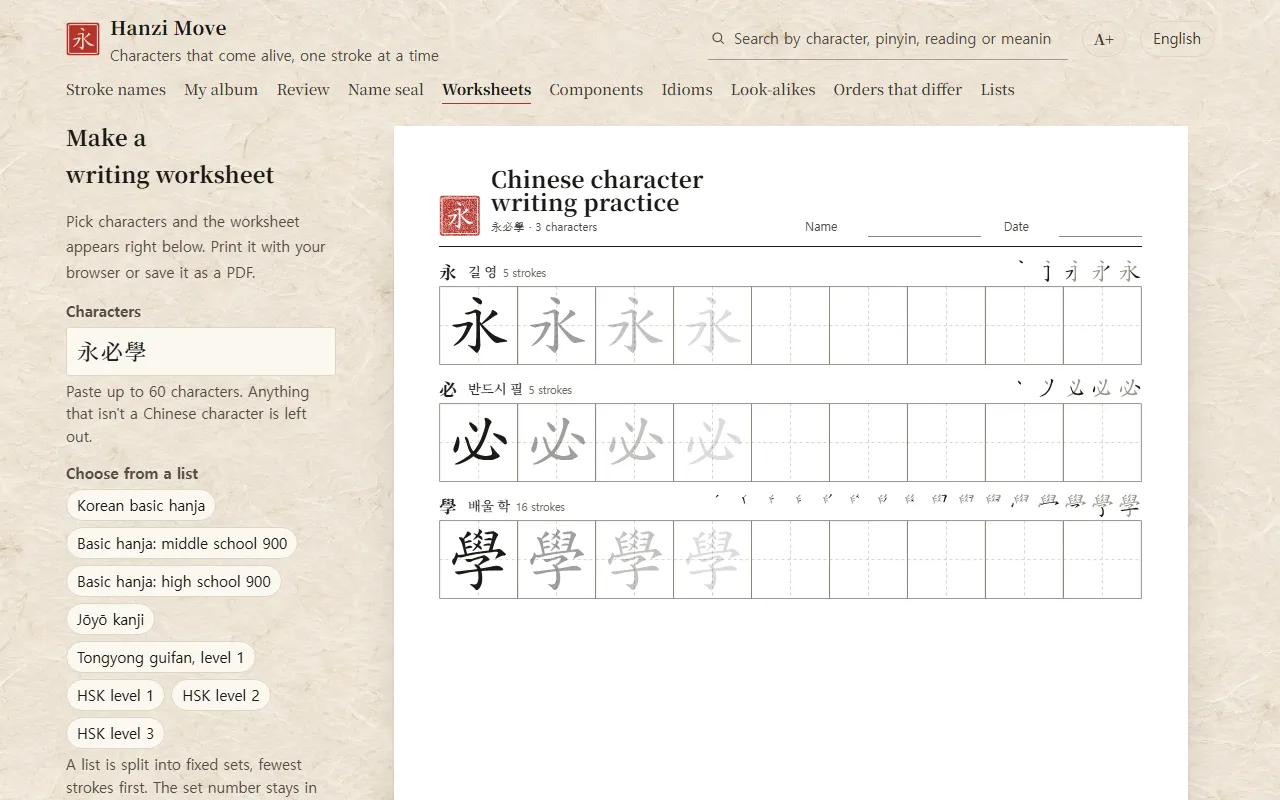
Worksheets in the top menu turns characters into a printable practice sheet. Paste up to 60 characters, or choose a list such as HSK level 1 or Jōyō kanji and the site splits it into sets, fewest strokes first. The set number stays in the address, so you can print the same set again later.
You can also choose:
- the stroke order (Korea, Japan, Mainland China or Taiwan)
- the grid (田, 米 or boxes only) and how many faint tracing copies to show
- whether to show the stroke-order strip, and which readings (On/kun, pinyin, Korean)
- box size, from Small to Large (children), paper (A4 or B5) and orientation
The sheet appears right below as you choose. Print it, or save it as a PDF from your browser's print dialog. According to the site's terms, worksheets are free to print for personal and classroom use.
6. More ways in
The top menu has a few more pages for browsing:
| Page | What it does |
|---|---|
| Stroke names | The basic strokes with their Korean, Chinese and Japanese names, starting from the Eight Principles of Yong (永字八法) |
| Components | Pick a component such as 氵 (water) or 木 (tree) and see the characters that contain it, grouped by position |
| Look-alikes | Groups of easily confused characters, such as 未 末 本 or 己 已 巳, side by side with a Trace link for each |
| Lists | HSK 3.0 levels, Jōyō and Jinmeiyō kanji, mainland China's general standard characters, and Korea's lists |
Idioms and Name seal are aimed at Korean users: Korean four-character idioms, and a seal made from the hanja of a Korean name.
Where the strokes come from
Hanzi Move draws its strokes from openly licensed data, and so do the screenshots in this post. Stroke data comes from AnimCJK and Make Me a Hanzi (Arphic Public License) and, for some Japanese characters that AnimCJK lacks, KanjiVG by Ulrich Apel (CC BY-SA 3.0). Readings and words come from sources including Unicode Unihan, KANJIDIC2 and JMdict (© EDRDG, CC BY-SA 4.0) and CC-CEDICT. Example sentences come from Tatoeba. The footer of every page carries these credits, and Download data lists every source and offers the site's own stroke files, one file per licence.
Next
Next, we look at Lookwave, which shows what the world looks up about Korea, measured by Wikipedia page views.
Frequently asked questions
Is the stroke order on Hanzi Move the official one?
Each tab says which data it follows: AnimCJK's sets for Korea, Japan, mainland China and Taiwan. The site lists the official standards of mainland China, Taiwan and Japan, and says that no official national order has been confirmed for Korea, so its Korean tab is a reference order. Its terms ask you to follow your textbook and teacher for exams and classes.
Which tab should I use if I am learning Japanese or Chinese?
Use the Japan tab for kanji, Mainland China for simplified Chinese, and Taiwan for traditional characters as written in Taiwan. The English site opens on the Korean order, so switch tabs first. The worksheet maker has the same four choices.
Do I need an account? Are my strokes uploaded?
There is no sign-up. Your strokes are checked on your own device and are not sent to the server. Your practice record, review dates and My album are kept only in your browser, so clearing the site's data deletes them.
Can I print stroke-order worksheets?
Yes. Open Worksheets, paste up to 60 characters or choose a list such as HSK level 1 or Jōyō kanji, then print from your browser or save as a PDF. The site's terms allow free printing for personal and classroom use.