Raeum
Korean traditional music on a painted stage: a guide to Raeum
Raeum stages Korean gugak and Western classical side by side. How its pieces, lyric translations, jangdan rhythms, instrument pairs and recording sources work.
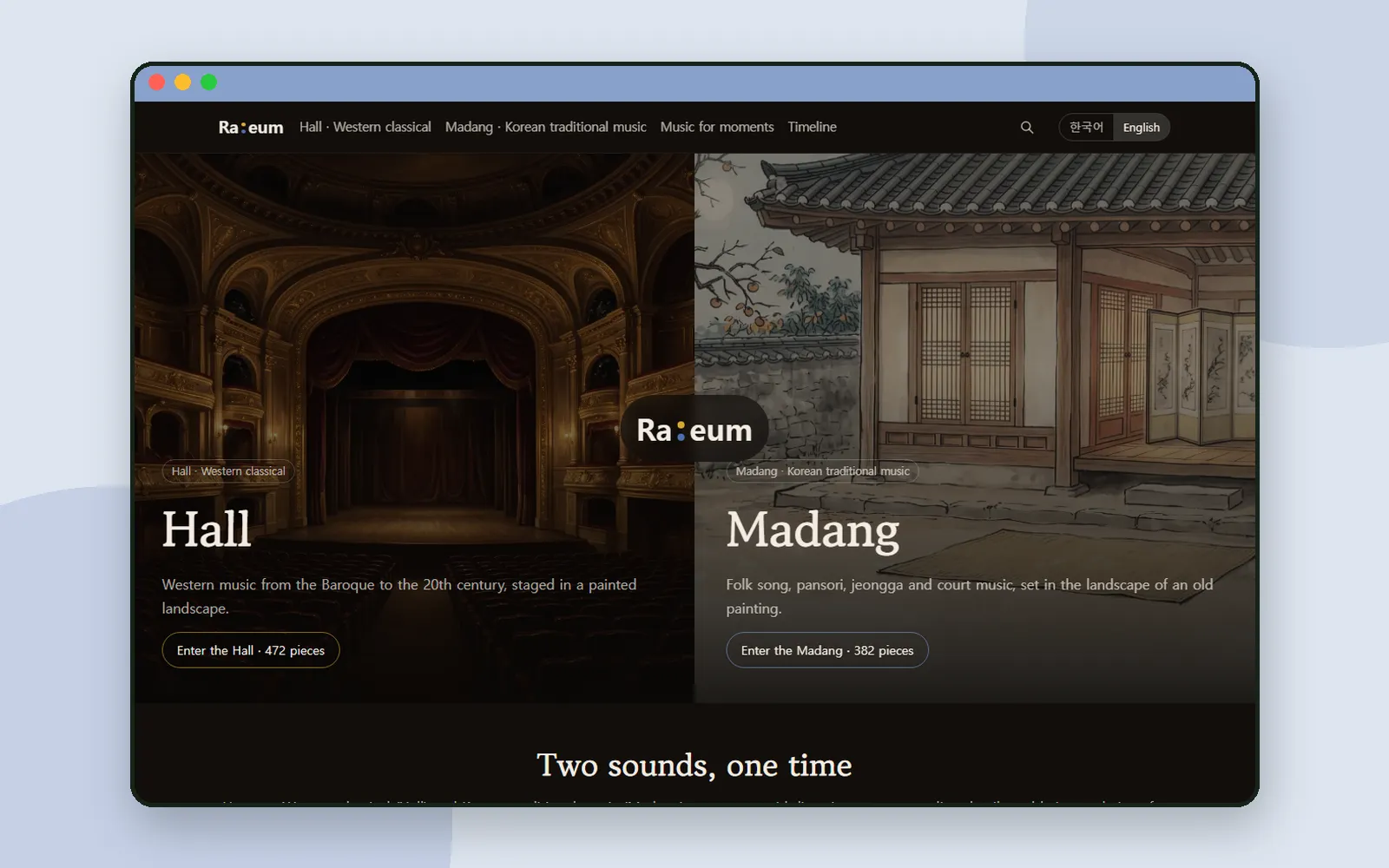
Raeum (the site writes it Ra:eum) is a listening site with two wings. The Hall holds Western classical music; the Madang, named after the open courtyard of a Korean house, holds Korean traditional music, or gugak. Every piece opens on a painted stage, with notes to guide your ear and, for songs, lyrics in Korean with English translations. There is no sign-up.
If you have been curious about gugak but never knew where to start, Raeum gives you a way in. This guide covers the two wings, how a piece page works, the pages built for newcomers, and something worth knowing before you press play outside Korea: where the recordings come from.
ZZXXCCVV siteRaeumWatch and listen to Western classical music and Korean gugakOpen1. Two doors: the Hall and the Madang
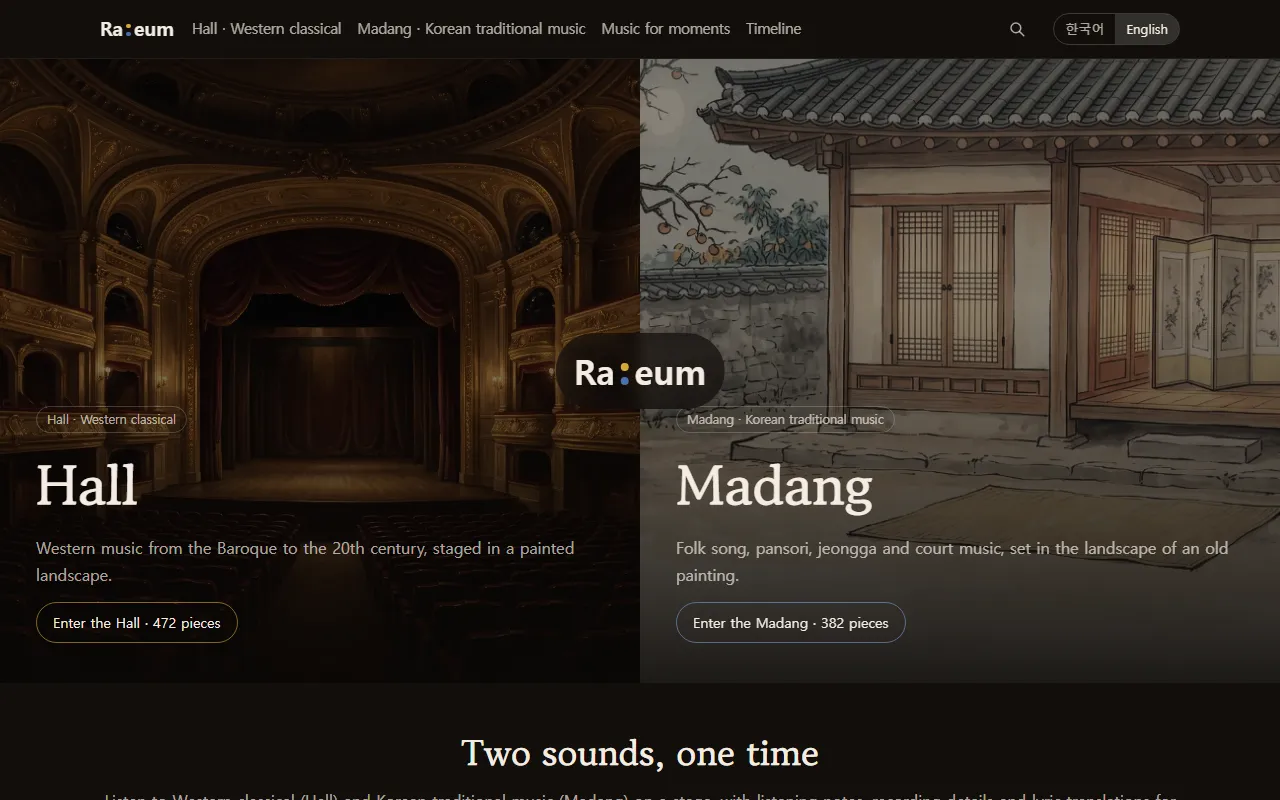
The front page splits in two. As of 1 November, the Hall holds more than 470 pieces and the Madang more than 380.
- Madang sorts its pieces into five families: Court music, Folk song, Jeongak (court and literati music), Pansori and Pungnyu (literati music).
- Hall sorts its pieces by era, from Baroque to the 20th century, and you can also browse by composer.
- The magnifying glass at the top opens search. The site's own examples are "Chopin", "Arirang", "symphony" and "pansori".
2. A gugak piece, staged
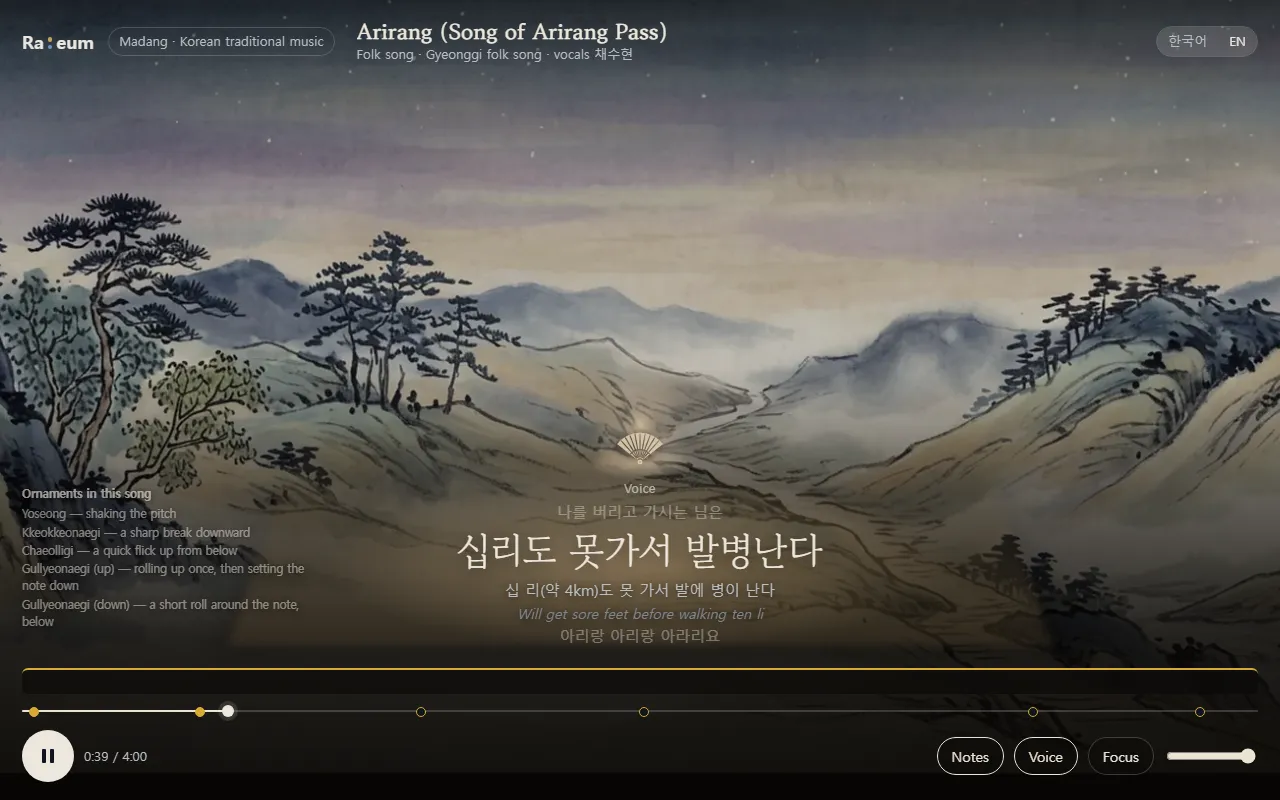
Open a piece in the Madang and the whole screen becomes a stage: a painted landscape behind, and a fan mark that, as the page explains, stands for "the singer's place". Take Arirang, the folk song most Koreans know by heart.
- How to listen: before you press play, a card in the middle gives three things to listen for.
- Lyrics on stage: while a song plays, the current line appears in Korean, with a modern Korean gloss for old words and an English translation underneath.
- Ornaments in this song: a short list on the left names the vocal ornaments (sigimsae) used in this song, such as yoseong, "shaking the pitch", so you can match the name to the sound as you hear it.
- Notes, Voice, Focus: the buttons at the bottom right. Notes are short comments tied to moments in the piece. Pieces with spoken commentary also show Voice.
3. New to gugak? Three places to start
The front page section "Between the two wings" links to these, and so does the top of the Madang.
New to gugak? is a short first guide. It explains the two big families, jeongak (the slow, dignified music of the court and scholars) and minsogak (the folk music of ordinary people), then instruments and ornaments, rhythmic cycles, pansori and regional folk song. It ends with a suggested listening order and a "Words to know" glossary.
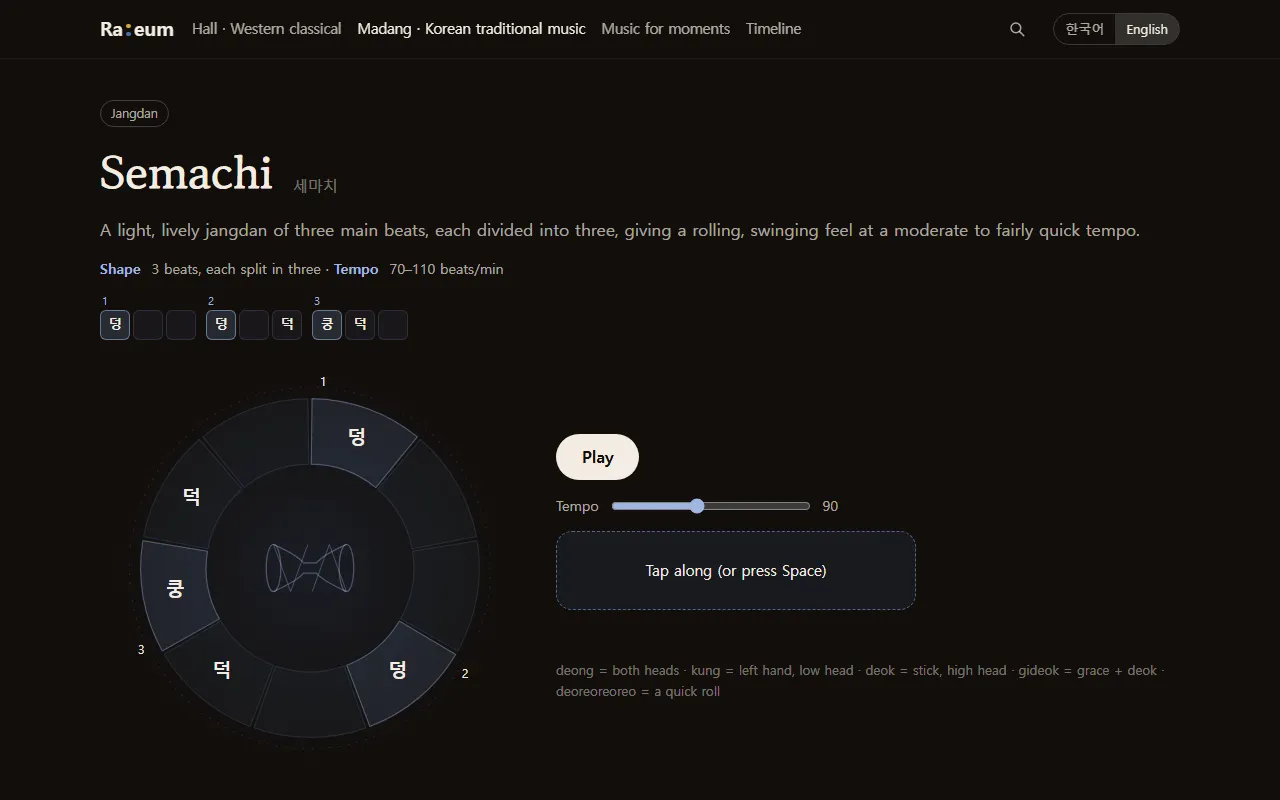
Jangdan: tap along covers eight Korean rhythmic cycles, slowest first, from jinyangjo to eotmori. Each cycle turns on a circle, one lap per cycle. A cycle's page has:
- its beat structure and usual tempo, with the janggu strokes written out and a key to what each stroke means
- Play, a Tempo slider and a Tap along pad you can also hit with the space bar
- real janggu recordings of that cycle, and songs that use it
Instrument cousins pairs a Korean instrument with a Western one that plays a similar part: haegeum and violin, daegeum and flute, gayageum and harp, janggu and timpani, piri and oboe, yanggeum and piano. Each pair compares how the two look, how they make sound, their tone, their role in the music and their history.
4. The Hall, and where you are listening from
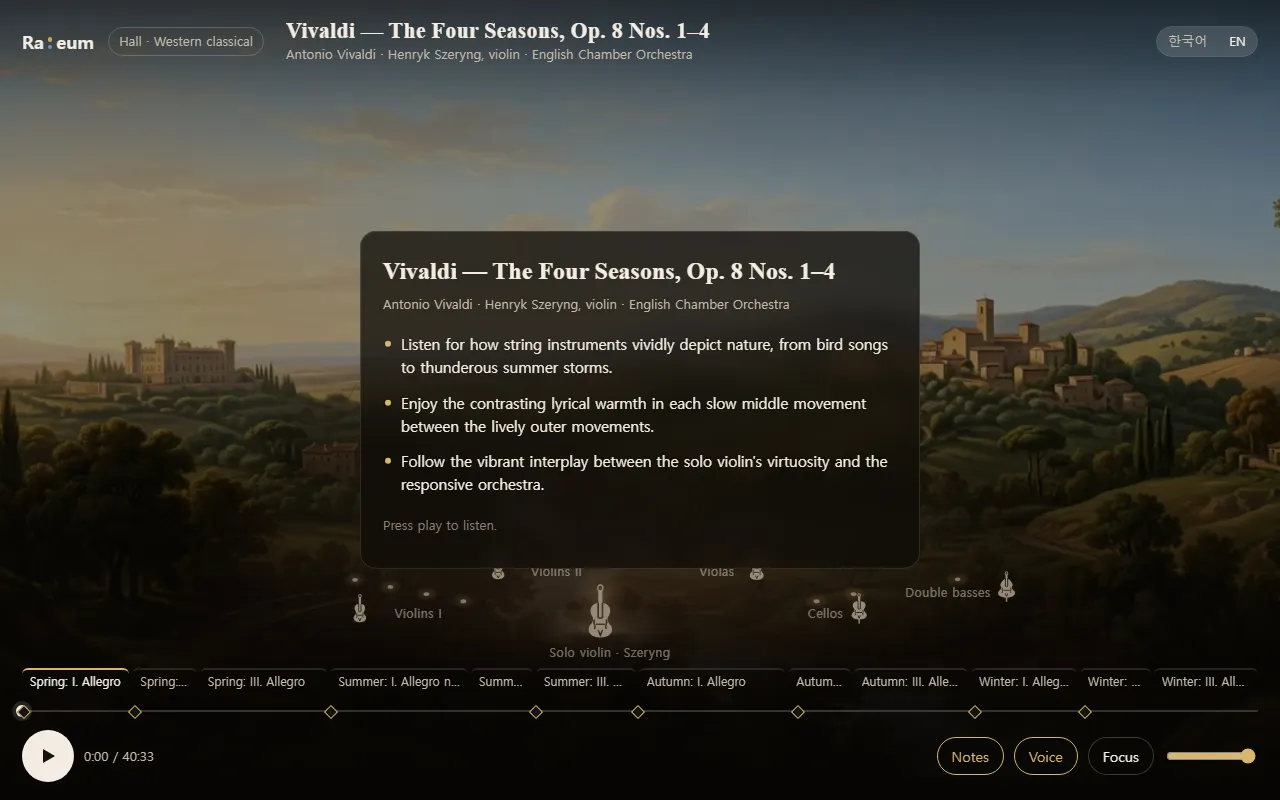
The Hall stages Western pieces the same way. Seats are set out to match the scoring, so the Four Seasons puts a solo violin in front of the strings, and movement chips above the progress bar take you straight to a movement. The lights follow the overall loudness of the recording; the site notes under "About the stage picture" that they do not show which instrument is playing. Each piece also lists "Meanwhile in Korea". For the Four Seasons, that is the reign of King Sukjong of Joseon.
You can still read your way through the Hall from anywhere. Its listening notes, stage layouts and the pages below are text and pictures.
| Page | What it does |
|---|---|
| Music for moments | Hall pieces for Weddings & celebrations, Gentle music for expecting parents, Before sleep, For study and focus, Morning and Rainy days, each with one line on why it fits |
| Same year, different sounds (Timeline) | Two lanes, one row per decade: when the Hall's pieces were written, and what was happening in Korean music at the time |
| One theme, two sounds | Spring, Love, Parting and longing, The moon and night, Water, sea and rivers, Mountains and nature, Feasts and celebration, Heroes and battle: pieces from both wings grouped by theme |
5. Where the recordings come from
Raeum lists a source and a licence for every recording. According to its Recording rights page, every work (composition and lyrics) is in the public domain in both Korea and the US, and every recording comes from one of three places:
| Source | Terms |
|---|---|
| Korea-only recordings | Recorded before 1 July 1987; rights expired in Korea, may still be protected abroad |
| Gugak learning dataset | National Gugak Center / Korea Culture Information Service, KOGL Type 1 |
| Korea Copyright Commission 2020 gugak recordings | Gongu Madang, CC BY 4.0, released without performer names |
Arirang, shown above, comes from the National Gugak Center's dataset. Even the janggu strokes on the Jangdan pages are cut from the Commission's CC BY 4.0 recordings, and the page says so.
According to the site's About page, the guide texts, the commentary and its narration, and the stage paintings were made with the help of AI tools, and no AI-generated music is used. If you spot a wrong title, translation or instrument name, or a rights problem, use Corrections & takedown at the bottom of any page.
Next
Next, we look at Hanzi Move, which shows the stroke order of Chinese characters, kanji and hanja one brushstroke at a time.
Frequently asked questions
Do I need an account to use Raeum?
No. Raeum has no sign-up or log-in. Open a piece and press play.
Can I listen to everything on Raeum from outside Korea?
Not everything. The site marks some recordings as Korea-only: recordings made before 1 July 1987 whose rights have expired in Korea but may still be protected in the US and EU. It asks listeners outside Korea not to play, download or share them. The Madang's recordings come from the National Gugak Center (KOGL Type 1) and the Korea Copyright Commission (CC BY 4.0). Each piece lists its source under "About this recording".
What do the Notes and Voice buttons do?
Notes are short comments tied to moments in a piece. The small circles on the progress bar mark them, and pressing a line in the Commentary list below the stage plays the piece from that moment. Pieces with spoken commentary also show a Voice button.
I have never heard gugak. Where should I start?
Open "New to gugak?" in the Madang. It explains the main families of Korean traditional music and suggests an order: folk songs first, then janggu-only rhythm tracks, then short danga before full pansori. It ends with a short glossary.